


Page 155 - Mathematics_Form_Two
P. 155
Sets


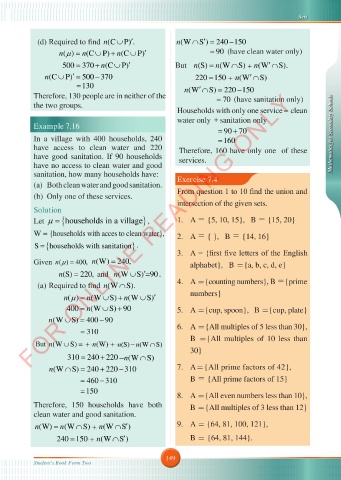
            (d) Required to find  (Cn  ∪ P) . ′       n (W ∩  S ) ′ =  240 150−
                                   +
                           n ( )µ =  n (C∪  P) n (C∪  P)′                    90=   (have clean water only)
                                                                   (W ∩(S) =
                         500 370 n=  +  (C∪  P)′      But    (S)nn  =  n n (W ∪ (Wn  S)+ (Wn (W)+ (S)n= ∩      n  ′∩ S) S)+ (W′∩  n S) − S).  n (W ∩  S)
                                                                            +
                 (Cn  ∪  P)′ =  500 370−                        220 150+ (Wn=S)n 220  ==      n (Wn (W)+n S) (S) n− S)    (W ∩  S)
                                                                           ′∩ ′∩
                                                                      +150+
                                                            (W ∪
                                 130=                      (Wn  ′∩  S) =  220 150−
          FOR ONLINE READING ONLY
           Therefore, 130 people are in neither of the             =  70  (have sanitation only)
           the two groups.
                                                       Households with only one service = clean

                                                       water only  + sanitation only
           Example 7�16                                                     90 70=  +
           In a  village  with  400  households,  240                         160=                   Mathematics for Secondary Schools
           have  access  to  clean  water  and  220    Therefore, 160 have only one  of these
           have good sanitation. If 90 households      services.
           have no access to clean water and good
           sanitation, how many households have:       Exercise 7�4
           (a)  Both clean water and good sanitation.
           (b)  Only one of these services.            From question 1 to 10 find the union and
           Solution                                    intersection of the given sets.
                                            }
                                                             =
                                                                               =
           Let  µ = {households in a village ,         1.  A   {5, 10, 15},   B   {15, 20}
           W = {households with acces to clean water},  2.  A   { },   B   {14, 16}
                                                                       =
                                                             =
                                         }
           S = {households with sanitation .
                                                       3.  A = {first five letters of the English
           Given  ( )n µ = 400,  (W)n  =  240,             alphabet},   B ={a, b, c, d, e}
                                             ′
                   n (S) =  220,  and   (Wn  ∪ S) =90.
                                                                                     =
            (a) Required to find  (Wn  ∩  S) =  .  240 220 310+  −  4.  A ={counting numbers}, B  {prime
                        ( )n µ =  n (W ∪  S) n (W ∪  S)′   numbers}
                                     +
                            400 n=  (W ∪  S) 90+       5.  A ={cup, spoon},   B ={cup, plate}
          400 =         n (W ∪  S) 90+  =  400 90−

                                   310=                6.  A ={All multiples of 5 less than 30},
                           +n
            But  (Wn (Wnn n ∪  ∪(W ∪ (W      (W)+ (S)n(W)+n(W)+ (S)nS) = (W)+ (S)n+       −(S) − (W − n n  nnn)+ −  (W ∩(W ∩(W ∩ (S)n(Wn  −  S)S)S)(Wn S)∩  ∩  S)  B  ={All multiples of 10 less than
                      S) = S) = S) = ∪
                                  +
                           +
                            +(W=
                            nnn∪S)
                                                           30}
                           310 240 220 n=  +  −  −  n (C∩ (W ∩  P) S)
                   (Wn  ∩  S) =  240 220 310+  −       7.  A={All prime factors of 42},
                                                             =
                                   460 310=  −             B   {All prime factors of 15}
                                   150=                8.  A ={All even numbers less than 10},
           Therefore,  150 households have both            B ={All multiples of 3 less than 12}
           clean water and good sanitation.

            nn    n n (W ∪ (Wn  S)+ (Wn (W)+ (S)n= ∩      n  ∩ S) S)+ (W ∩  S ) ′ n ) −S′     n (W ∩  S)  9.  A = {64, 81, 100, 121},
             (W) =
                    (W ∩ (W) =
                             +
                       240 150+ (Wn= S)n 240 150+ (Wn=  =      n (W)+ S ) ′ (S) n−S ) ′          S)  B = {64, 81, 144}.
                                  ∩n ∩
                   (W ∪
                                           (W ∩
                            +
                                                   149
           Student's Book Form Two
     MATHEMATIC F2 v5.indd   149                                                          11/10/2024   20:13:22
                                                                                          11/10/2024   20:13:22
     MATHEMATIC F2 v5.indd   149

