


Page 160 - Mathematics_Form_Two
P. 160
Sets


                                                          n (E ∩  K ) ′ =  n (E) n−  (E ∩  K)
                                                                           = 40 – 30 = 10
                                                          Therefore, 10 students study English
                                                          only.
                                                      (b)  The number of students who study
          FOR ONLINE READING ONLY
                                                          Kiswahili only is given by:
            (a)  Elements of B only = 6 – 4 = 2.
     Mathematics for Secondary Schools  (b)  A ⊂ B.  This is because all elements                 = 60 – 30 = 30
                 Therefore, B has 4 + 2 = 6 elements.

                                                                        (K) n−
                                                                       n
                                                                                    K)
                                                                               (E ∩
                                                           n
                                                            (K ∩
                                                                 E ) ′ =
                                                           The number of students who study
                 in set A are contained in set B.
                                                           English or Kiswahili or both are:
            Example 7�24
                                                                     30+30+10 = 70
            In a class of 120 students, 40 study
                                                           who study  neither  Kiswahili  nor
            English,  60 study Kiswahili,  and  30         Therefore,  the  number  of students
            study both Kiswahili and English. Find         English are:
            the number of students who study:              120 – 70 = 50 students.
            (a) English only.                          Example 7�25
            (b) Neither English nor Kiswahili.         In a certain  school, 50 students eat


            Solution                                   meat, 60 eat fish, and 25 eat both meat
            Let    = {All students in the school}      and fish. Assuming that every student
                                                       eats meat or fish, find the total number
            E = {All students who study English}       of students in the school.

            K = {All students who study Kiswahili}     Solution
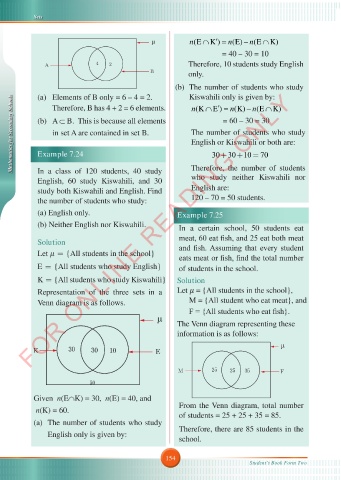
            Representation  of the three sets in a     Let    = {All students in the school},
            Venn diagram is as follows.                      M = {All student who eat meat}, and
                                                             F = {All students who eat fish}.
                                                       The Venn diagram representing these
                                                       information is as follows:


           Given  n(E∩K) = 30,  n(E) = 40, and
            n(K) = 60.                                 From the Venn diagram, total number
                                                       of students = 25 + 25 + 35 = 85.
           (a)  The number of students who study
               English only is given by:               Therefore, there are 85 students in the
                                                       school.


                                                   154
                                                                            Student's Book Form Two


                                                                                          11/10/2024   20:13:33
     MATHEMATIC F2 v5.indd   154                                                          11/10/2024   20:13:33
     MATHEMATIC F2 v5.indd   154

