


Page 161 - Mathematics_Form_Two
P. 161
Sets
In general, the number of elements in two 2. Use the following Venn diagram to
sets is connected by the formula: describe the relationship between
(A ∩ (A ∩ (A ∩
(A ∪ (A ∪ (A ∪
(A)+ (B)n(A)+ (B)n(A)+ (B)n
nnn B) = B) = B) = nnn − − − nnn B)B)B) the sets A and B.
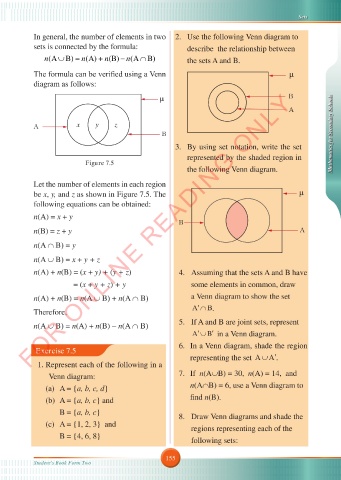
The formula can be verified using a Venn
diagram as follows:
FOR ONLINE READING ONLY
Mathematics for Secondary Schools
x y z
3. By using set notation, write the set
represented by the shaded region in
Figure 7�5
the following Venn diagram.
Let the number of elements in each region
be x, y, and z as shown in Figure 7.5. The
following equations can be obtained:
n(A) = x + y
n(B) = z + y
n(A ∩ B) = y
n(A ∪ B) = x + y + z
n(A) + n(B) = (x + y) + (y + z) 4. Assuming that the sets A and B have
= (x + y + z) + y some elements in common, draw
n(A) + n(B) = n(A ∪ B) + n(A ∩ B) a Venn diagram to show the set
Therefore, A¢Ç B, .
n(A ∪ B) = n(A) + n(B) − n(A ∩ B) 5. If A and B are joint sets, represent
A B in a Venn diagram.
6. In a Venn diagram, shade the region
Exercise 7�5
representing the set A È A¢ = . U.
1. Represent each of the following in a
Venn diagram: 7. If n(A∪B) = 30, n(A) = 14, and
(a) A = {a, b, c, d} n(A∩B) = 6, use a Venn diagram to
(b) A = {a, b, c} and find n(B).
B = {a, b, c} 8. Draw Venn diagrams and shade the
(c) A = {1, 2, 3} and regions representing each of the
B = {4, 6, 8}
following sets:
155
Student's Book Form Two
MATHEMATIC F2 v5.indd 155 11/10/2024 20:13:34
MATHEMATIC F2 v5.indd 155
11/10/2024 20:13:34

