


Page 182 - Mathematics_Form_Two
P. 182
Trigonometry


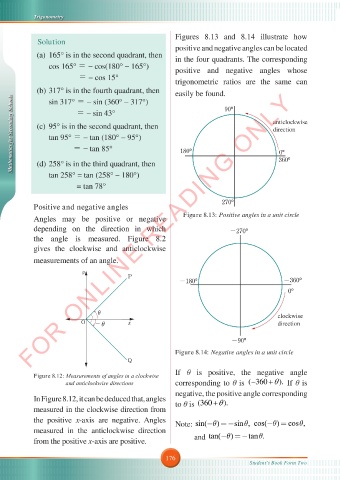
                                                      Figures 8.13 and 8.14 illustrate  how
            Solution
                                                      positive and negative angles can be located
            (a) 165° is in the second quadrant, then   in the four quadrants. The corresponding
                         =
                cos 165°   − cos(180° − 165°)         positive  and  negative  angles  whose
                         =  − cos 15°                 trigonometric  ratios  are the  same  can
            (b) 317° is in the fourth quadrant, then  easily be found.
          FOR ONLINE READING ONLY
     Mathematics for Secondary Schools  (c) 95° is in the second quadrant, then     anticlockwise
                         =
                sin 317°   − sin (360° − 317°)
                        =

                            − sin 43°
                                                                                    direction
                       =
                tan 95°   − tan (180° − 95°)
                       =

                           − tan 85°
            (d) 258° is in the third quadrant, then
                tan 258° = tan (258° − 180°)
                        = tan 78°


           Positive and negative angles
           Angles may  be  positive  or negative        Figure 8�13: Positive angles in a unit circle
           depending on the direction in which
           the angle is  measured. Figure 8.2
           gives the clockwise and anticlockwise
           measurements of an angle.

                          y
                                        P


                              i
                                                                                     clockwise
                          O   − θ       x                                            direction


                                                      Figure 8�14: Negative angles in a unit circle
                                        Q
                                                      If  θ is positive, the negative angle
           Figure 8�12: Measurements of angles in a clockwise
                     and anticlockwise directions     corresponding to θ is  ( 360 θ−  +  ).  If θ is
                                                      negative, the positive angle corresponding
           In Figure 8.12, it can be deduced that, angles   to θ is  (360 θ+  ).
           measured in the clockwise direction from
           the positive  x-axis are negative.  Angles   Note: sin(−θ) =−sinθ,   cos(−θ) = cosθ,
           measured in the anticlockwise direction
           from the positive x-axis are positive.               and  tan(−θ) =−tanθ.


                                                   176
                                                                            Student's Book Form Two


                                                                                          11/10/2024   20:14:01
     MATHEMATIC F2 v5.indd   176
     MATHEMATIC F2 v5.indd   176                                                          11/10/2024   20:14:01

