


Page 184 - Mathematics_Form_Two
P. 184
Trigonometry


            4.   Express each of the following in     Ttherefore, the sine of an angle is equal
                terms of cos 20º:                     to the cosine of its complement and vice
                (a)  cos 160°  (b)  cos 200°          versa. From Figure 8.15, it follows that
                                                        sin A
                (c)  cos 340°                          sin A  =  =  a a  c  c =  =  a a
                                                                ÷   ÷  ÷
                                                        cosA
             5.   Express each of the following in     cosA    b b  b  b  c  c
          FOR ONLINE READING ONLY
                terms of tan 40º:  (b)  tan 220°      But  tan A =  a  .
     Mathematics for Secondary Schools    6.  Without using a calculator, find the   Hence,  cos A  =  tan A .   .
                                                                  c

                (a)  tan 140°
                                                              sin A
                (c)  tan 320°
                value of each of the following:
                                                      Also,
                                                                         and
                                     ⎛
                                         ⎞
                                        6 ⎟
                    sin(−150)cos315⎜
                                         ⎟
                                     ⎜
                (a)
                         tan300
                                     ⎜ ⎜
                                     ⎝
                                   ⎛  ⎜ 12 ⎟ ⎟ ⎟ ⎠                                      .
                                       ⎞
                                                                     2
                                       ⎟
                (b)  tan(−30)cos60 ⎜  6 ⎟             But  a +  2  c =  2  b (Pythagoras’ theorem)
                                                                      (Pythagoras theorem)
                                   ⎜
                                       ⎟
                                       ⎟
                       sin(−45)    ⎜ 12 ⎟                                      2
                                   ⎜ ⎜
                                       ⎠
                                   ⎝
                                                                        2
                                                               2
                                                      Thus, sin A + cos A  =  b  = 1.
                                                                             b 2
           Relationship between  trigonometric        Therefore, sin A + cos A =1.
                                                                            2
                                                                    2
           ratios
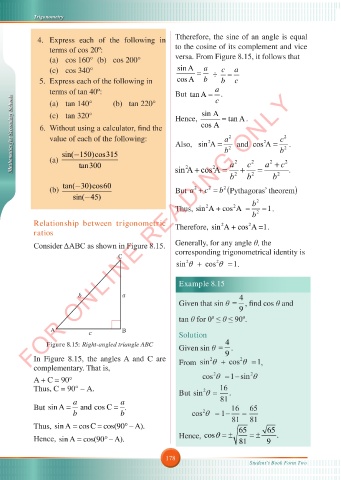
           Consider ΔABC as shown in Figure 8.15.     Generally, for any angle θ, the
                                                      corresponding trigonometrical identity is
                                                      sin q  2     cos  q +  2  =    1.
                                                       Example 8�15
                                                                         4
                                                                  sinθ
                                                       Given that sin θ  =  , find cos θ and
                                                                         9
                                                       tan θ for 0º ≤ θ ≤ 90º.
                                                       Solution
               Figure 8�15: Right-angled triangle ABC  Given sin θ  =  4  .
                                                              sinθ
           In Figure 8.15, the angles A and C are      From  sin q  2     cos  q + 9  2  =    1,
           complementary. That is,
           A + C = 90°                                         cos   1 sinq  2  2    q = -
           Thus, C = 90° − A.                                      16
                                                              2
                                                       But sin q =      .
                       a             a                              81
           But sin A =   and cos C = .                                 16    65
                       b             b                     cos   q = 1-   =
                                                              2
           Thus, sin A = cosC cos(90=  °− A).                          81 65  81  65
           Hence, sin A =  cos(90°− A).                Hence,  cosθ =  ±  81  =  ±  9  .


                                                   178
                                                                            Student's Book Form Two


                                                                                          11/10/2024   20:14:05
     MATHEMATIC F2 v5.indd   178
     MATHEMATIC F2 v5.indd   178                                                          11/10/2024   20:14:05

