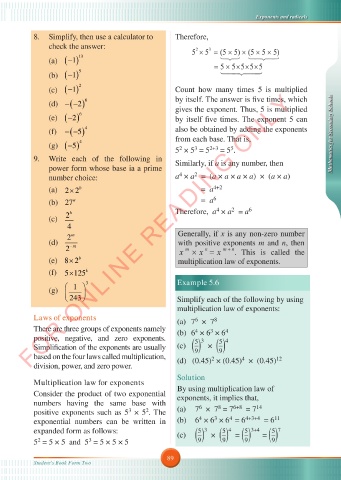
Page 95 - Mathematics_Form_Two
P. 95

Exponents and radicals


           8.  Simplify, then use a calculator to     Therefore,
                check the answer:                          5  2  5 ´  3  ( =  5  5 ´  )  ( ´  5  5 ´  5    ) ´
                (a)  ( ) 1−  13                                   =  !"#    !$"$#

                                                                    5 5555´ ´´´
                (b)  ( ) 1−  5                                      !""#""$

                (c)  ( ) 1−  2                        Count how many times 5 is multiplied
          FOR ONLINE READING ONLY
                (d)  ( ) 2−−  6                       by itself. The answer is five times, which
                                                      gives the exponent. Thus, 5 is multiplied
                (e)  ( ) 2−  6                        by itself five times. The exponent 5 can

                      ( ) 5
                (f)  −−    4                          also be obtained by adding the exponents       Mathematics for Secondary Schools
                (g)  ( ) 5−  4                        from each base. That is,
                                                                2+3
                                                                    = 5 .
                                                                       5
                                                            3
                                                      5  × 5  = 5
                                                       2
           9.  Write  each  of  the  following  in    Similarly, if a is any number, then
                power form whose base ia a prime
                                                       4
                                                            2
                number choice:                        a  × a   =  (a × a × a × a)  ×  (a × a)
                (a)  22×  b                                     =  a 4+2
                (b)  27 a                                       =  a 6 4  2  6
                (c)   2 h                             Therefore,  a  × a   = a
                     4
                     2 m                               Generally, if x is any non-zero number
                (d)                                    with positive exponents m and n, then
                     2 − m                             x  m  x ´  n  x =  m  n +    .  This is called  the
                (e)  82×  b                            multiplication law of exponents.

                (f)  5 125×  k

                (g)       1     3                  Example 5�6
                       243                           Simplify each of the following by using
                                                       multiplication law of exponents:
           Laws of exponents                           (a)  7   ×  7
                                                            6
                                                                  8
           There are three groups of exponents namely   (b)   6  × 6  × 6 4
                                                                 3
                                                            4
           positive, negative, and  zero exponents.         5 3    5 4
                                                                 ×
           Simplification of the exponents are usually   (c)    ( ) ( )
                                                                   9
                                                            9
           based on the four laws called multiplication,   (d)   (0.45)  × (0.45)   ×  (0.45)
                                                                          4
                                                                 2
                                                                                     12
           division, power, and zero power.
                                                       Solution
           Multiplication law for exponents
           Consider the product of two exponential     By using multiplication law of
                                                       exponents, it implies that,
           numbers having the same base with                 6     8    6+8    14
                                        3
                                             2
           positive exponents such as 5  × 5 . The     (a)  7   ×  7  = 7    = 7
                                                                  3
                                                                      4
                                                             4
           exponential  numbers  can  be  written  in   (b)  6  × 6  × 6 = 6 4+3+4   = 6 11
           expanded form as follows:                   (c)   ( ) ( ) ( )        =  ( )
                                                                    5 4
                                                             5 3
                                                                                   5 7
                                                                           5 3+4
                                                                         =
                                                                  ×
            2
           5  = 5 × 5  and  5  = 5 × 5 × 5                   9      9      9       9
                            3
                                                    89
           Student's Book Form Two
                                                                                          11/10/2024   20:12:13
     MATHEMATIC F2 v5.indd   89
     MATHEMATIC F2 v5.indd   89                                                           11/10/2024   20:12:13
   90   91   92   93   94   95   96   97   98   99   100