


Page 98 - Mathematics_Form_Two
P. 98
Exponents and radicals
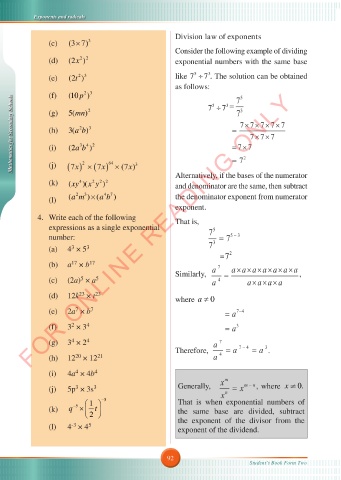
Division law of exponents
(c) (3 7)´ 3
Consider the following example of dividing
(d) (2 )x 22 exponential numbers with the same base
5
3
(e) (2 )t 23 like 7 ÷ 7. The solution can be obtained
as follows: 5 5 7 = 7 5
FOR ONLINE READING ONLY
23
(f)
(10p
)
Mathematics for Secondary Schools (g) 5(mn ) ) 2 3 ) = 7 77 777
3
7 ÷7 ÷
7
3
3
77777´ ´ ´ ´
2
3(ab
(h)
´ ´
3 42
= ´
(2a b
(i)
2
2
(j)
7x
7x
( ) ´
Alternatively, if the bases of the numerator
(k) ( ) ´ (xy )(x y ) 64 (7x 3 ) = 7
2
2 2
4
and denominator are the same, then subtract
3
4 7
2
(l) (a m )×(a b ) the denominator exponent from numerator
exponent.
4. Write each of the following That is,
expressions as a single exponential 5
number: 7 3 = 7 5 3 -
(a) 4 × 5 3 7
3
7 = 2
17
(b) a × b 17 7
Similarly, a = aaaaaaa´´´´´´ ,
5
(c) (2a) × a a 7 aaaaaaa´´´´´´
5
4
aaaa´´´
a
23
(d) 12k × t 23 where a ≠ 0a 4 = = a 74 - aaaa´´´
(e) 2a × b 7 = = a a 3 74 -
7
(f) 3 × 3 4 = a 3
2
(g) 3 × 2 4 a 7
4
Therefore, = a 7 4 - = a 3 .
(h) 12 × 12 21 a 4
20
(i) 4a × 4b 4 m
4
(j) 5p × 3s 3 Generally, x n = x m n - , where x ≠ 0.
3
x
5
−
(k) q × 1 t − 5 That is when exponential numbers of
the same base are divided, subtract
2 the exponent of the divisor from the
-3
(l) 4 × 4 5 exponent of the dividend.
92
Student's Book Form Two
11/10/2024 20:12:15
MATHEMATIC F2 v5.indd 92
MATHEMATIC F2 v5.indd 92 11/10/2024 20:12:15

