


Page 96 - Mathematics_Form_Two
P. 96
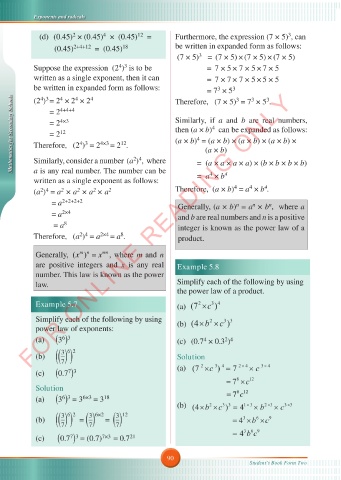
Exponents and radicals


             (d)  (0.45)  × (0.45)   ×  (0.45)   =    Furthermore, the expression (7 × 5) , can
                                4
                                           12
                                                                                        3
                       2
                 (0.45) 2+4+12   =  (0.45) 18         be written in expanded form as follows:


                                                             3

                                                       (7 × 5)    =  (7 × 5) × (7 × 5) × (7 × 5)
                                     4 3

           Suppose the expression  (2 )  is to be               = 7 × 5 × 7 × 5 × 7 × 5


           written as a single exponent, then it can            = 7 × 7 × 7 × 5 × 5 × 5


           be written in expanded form as follows:    Therefore,   (7 × 5)  = 7  × 5 .
                                                                = 7  × 5
                                                                   3
                                                                       3
          FOR ONLINE READING ONLY
     Mathematics for Secondary Schools        Therefore,   (2 )  = 2 4×3  = 2 .  Similarly, if  a and  b are real numbers,
             4 3
                            4
                        4
                   4
           (2 )  = 2  × 2  × 2
                                                                             3
                                                                        3
                                                                                  3
                   4+4+4
                = 2

                   4×3

                = 2
                                                      then (a × b)   can be expanded as follows:
                                                                 4
                   12
                = 2
                                                             4
                                                      (a × b)  = (a × b) × (a × b) × (a × b) ×
                                     12
                         4 3
                                                               (a × b)
                                         2 4
           Similarly, consider a number  (a ) ,  where
           a is any real number. The number can be
                                                                4
                                                                     4
                                                              =  a  × b
           written as a single exponent as follows:           =  (a × a × a × a) × (b × b × b × b)
                                                                                 4
                                                                        4
                                                                            4
                             2
           (a )  = a  × a  × a × a 2                  Therefore,  (a × b)  = a  × b .
                        2
             2 4
                   2
                    = a 2+2+2+2                        Generally, (a × b)  = a  × b ,  where a
                                                                        n
                                                                             n
                                                                                  n
                    = a 2×4                            and b are real numbers and n is a positive
                  = a 8                                integer is known as the power law of a
                                     8
                         2 4
           Therefore,   (a )  = a 2×4  = a .           product.
                                mn
            Generally,  (x m n  x , where m and n
                          ) =
            are positive integers and  x is any real   Example 5�8
            number. This law is known as the power
            law.                                       Simplify each of the following by using
                                                       the power law of a product.
            Example 5�7                                (a)  (7 ´ c 34
                                                                  )
                                                             2
            Simplify each of the following by using    (b)  (4 b ´  2  c ´  33   )
            power law of exponents:
            (a)  (3 )                                  (c)  (0.7  × 0.3 )
                    6 3
                                                               4
                                                                     2 4
                  (( ) )
                   3 6 2
            (b)    7                                   Solution
                                                              2
                                                                   ) =
            (c)  (0.7 )                                (a)  (7 ´ c  3 4  7  2 4´  ´  c  34´
                      7 3
                                                                         8
                                                                     =  7 ´ c 12
            Solution                                                     8 12
                                                                      =
                    6 3
                                18
            (a)  (3 )  = 3 6×3  = 3                    (b)   (4 b ´  2  c ´  3 3  7 c 1 3´  b ´  2 3´  c ´  33´
                                                                          4
                                                                     ) =
                  (( ) ) ( )       ( )
                                    3 12
                   3 6 2
                            3 6×2
            (b)    7      =   7    =     7                             = 4 ´  3  b  6  c ´  9
                                                                           3
                                                                             69
                                                                       =  4 b c
            (c)   (0.7 )  = (0.7) 7×3   = 0.7 21
                      7 3
                                                    90
                                                                            Student's Book Form Two
                                                                                          11/10/2024   20:12:14
     MATHEMATIC F2 v5.indd   90                                                           11/10/2024   20:12:14
     MATHEMATIC F2 v5.indd   90

