


Page 111 - Physics_Form_2
P. 111
Magnetism

           inserted in the solenoid, and a large current
           is passed through  the  wire.  The  number  of              Activity 3.5
           turns of the wire is also increased.  This is     Aim:       To magnetise a steel
           an industrial  way of making a magnet.  The                  bar
           solenoid produces an electromagnet that acts      Materials:  steel bar, battery,
           like a bar magnet.
          FOR ONLINE READING ONLY
                                                                        switch, solenoid of
                                                                        copper wire, iron
                                                                        filings

                                                             Procedure
                                                            1.  Test the steel bar for magnetic
                                                                properties by using iron filings.
                                                            2.  Connect the battery to the
                                                                solenoid and the switch.
                                                            3.  Place the steel bar inside the

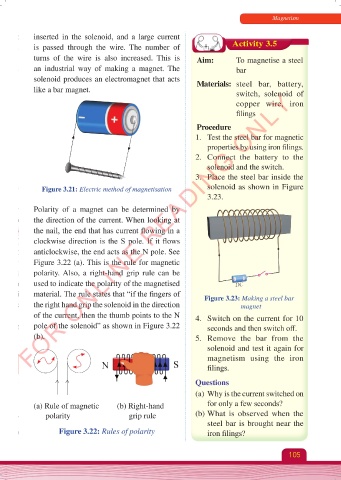
              Figure 3.21: Electric method of magnetisation     solenoid as shown in Figure
                                                                3.23.
           Polarity of a magnet can be determined  by
           the direction of the current. When looking at
           the nail, the end that has current flowing in a
           clockwise direction is the S pole. If it flows
           anticlockwise, the end acts as the N pole. See
           Figure 3.22 (a). This is the rule for magnetic
           polarity. Also, a right-hand grip rule can be
           used to indicate the polarity of the magnetised
           material. The rule states that “if the fingers of   Figure 3.23: Making a steel bar
           the right hand grip the solenoid in the direction               magnet
           of the current, then the thumb points to the N   4.  Switch on the current for 10
           pole of the solenoid” as shown in Figure 3.22        seconds and then switch off.
           (b).                                             5.  Remove the bar from the

                                                                solenoid and test it again for
                                                                magnetism  using the iron
                                                                filings.
                                                            Questions
                                                            (a) Why is the current switched on

           (a) Rule of magnetic         (b) Right-hand          for only a few seconds?
                 polarity                    grip rule      (b) What is observed when the
                                                                steel bar is brought near the
                   Figure 3.22: Rules of polarity               iron filings?


                                                                                        105


     Physics Form 2 Final.indd   105                                                        25/10/2025   10:26

