


Page 107 - Physics_Form_2
P. 107
Magnetism

             8.  Moving  coil meters.               attracted by the magnet? What are their
                A horseshoe magnet is               characteristics?
                used in voltmeters and
                ammeters. It is an inbuilt      (c)  Which of the objects could not be attracted
                part of these devices that          by the magnet? Why?
                enables the pointers to     2.   A magnet is cut into two equal pieces. What
          FOR ONLINE READING ONLY
                move in a direction of          happens to the magnetic poles of each piece, and
                increasing voltage or           why?
                current.                    3.  A student argues that all metals are magnetic.
                                                Do you agree or disagree? Explain your answer

                     Task 3.1                   with examples.
                                            4.  You are asked to design a simple tool for separating

              In groups, search the             magnetic materials from a pile of mixed waste
              internet or other sources,        at a recycling centre. The pile contains nails,
              then    describe   other          plastic wrappers, glass pieces, iron rods, and
              applications  of magnets.         paper. Describe the tool you would design and
              Write a report on your            the method by which it operates.
              findings and present your
              work to the class.
                                           Magnetisation and demagnetisation
                 Exercise 3.1              Magnets are manufactured by aligning the tiny atomic

             1.  In a certain primary      magnets of a material. The process of making a magnet
                school, a teacher          is called magnetisation. Likewise, demagnetisation is
                demonstrated  how          the process of destroying or removing the magnetism
                magnets work by giving     in a magnetised material.
                students different objects
                like a nail, plastic ruler,   Magnetisation
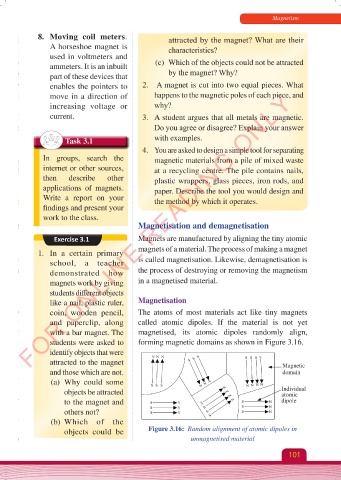
                coin, wooden pencil,       The atoms  of most materials  act  like  tiny  magnets
                and paperclip, along       called  atomic  dipoles. If the material  is not yet
                with a bar magnet. The     magnetised,  its  atomic  dipoles  randomly  align,
                students were asked to     forming magnetic domains as shown in Figure 3.16.
                identify objects that were
                attracted to the magnet                                               Magnetic
                and those which are not.                                              domain
                (a)  Why could some
                    objects be attracted                                              Individual
                                                                                      atomic
                    to the magnet and                                                 dipole
                    others not?
                (b)  Which  of  the
                    objects could be          Figure 3.16:  Random alignment of atomic dipoles in
                                                           unmagnetised material

                                                                                        101


     Physics Form 2 Final.indd   101                                                        25/10/2025   10:26

