


Page 103 - Physics_Form_2
P. 103
Magnetism

             2.  Permanent magnets. These retain
                some magnetism even after the                     Activity 3.2
                external magnetic field is removed.     Aim:        To investigate the properties
                Such  materials  include  an  alloy                 of magnets
                composed of aluminium, nickel           Materials:  bar magnets, block of
                and cobalt (Alnico), or ceramic-like                wood, iron filings, water,
          FOR ONLINE READING ONLY
                material made from a mixture of iron                string, compass needle,
                oxides with nickel, strontium, or cobalt            retort stand
                (ferrites) that become magnetised in    Procedure
                a magnetic field. These magnets may     1.  Perform the following steps:
                be naturally occurring “rare earth”        (a)  Position the north pole of one
                elements or chemical compounds. An             bar magnet close to the south
                example of a permanent magnet is the           pole of another bar magnet.
                bar magnet shown in Figure 3.5.            (b)  Bring the two north poles close,
                                                               then do the same with the two
                                                               south poles.
                                                           (c)  Make a note of what you
                                                               observe.
                                                           (d)  Spread some iron filings onto
                     Figure 3.5: Bar magnet                    a piece of paper, then hold the
                                                               north pole of a magnet near the

           Properties of magnets                               filings without touching them.
           When you closely examine a bar magnet,          (e)  Repeat this  by  bringing the
                                                               south pole close to the filings,
           you see one end marked N and the other              again without contact.
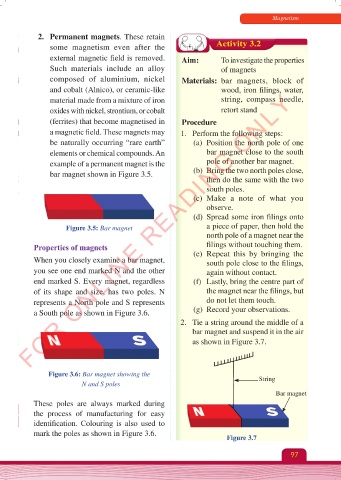
           end marked S. Every magnet, regardless          (f)  Lastly, bring the centre part of
           of  its  shape  and size,  has  two poles.  N       the magnet near the filings, but
           represents a North pole and S represents            do not let them touch.
           a South pole as shown in Figure 3.6.            (g)  Record your observations.
                                                        2.  Tie a string around the middle of a
                                                           bar magnet and suspend it in the air
                                                           as shown in Figure 3.7.


                Figure 3.6: Bar magnet showing the                             String
                           N and S poles
                                                                                    Bar magnet
           These poles are always marked during
           the  process of manufacturing  for  easy
           identification.  Colouring  is  also  used  to
           mark the poles as shown in Figure 3.6.
                                                                      Figure 3.7

                                                                                         97


     Physics Form 2 Final.indd   97                                                         25/10/2025   10:26

