


Page 104 - Physics_Form_2
P. 104
Physics for Secondary Schools


             3.  Gently push one end of the magnet so that it slowly spins and comes to rest.
                Note the direction in which the magnet’s north pole is pointing.
             4.  Push the magnet again and wait for it to come to rest.
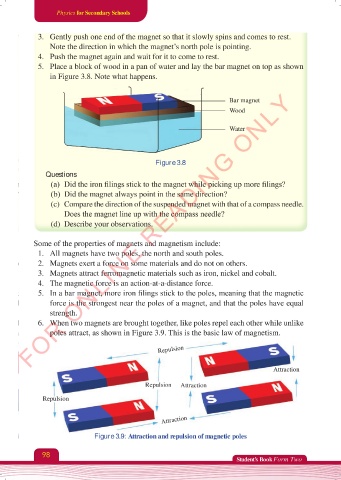
             5.  Place a block of wood in a pan of water and lay the bar magnet on top as shown
                in Figure 3.8. Note what happens.

          FOR ONLINE READING ONLY
                                                                      Bar magnet
                                                                      Wood

                                                                      Water


                                                Figure 3.8
               Questions
                (a)  Did the iron filings stick to the magnet while picking up more filings?
                (b)  Did the magnet always point in the same direction?
                (c)  Compare the direction of the suspended magnet with that of a compass needle.
                    Does the magnet line up with the compass needle?
                (d)  Describe your observations.


           Some of the properties of magnets and magnetism include:
             1.  All magnets have two poles, the north and south poles.
             2.  Magnets exert a force on some materials and do not on others.
             3.  Magnets attract ferromagnetic materials such as iron, nickel and cobalt.
             4.  The magnetic force is an action-at-a-distance force.
             5.  In a bar magnet, more iron filings stick to the poles, meaning that the magnetic
                force is the strongest near the poles of a magnet, and that the poles have equal
                strength.
             6.  When two magnets are brought together, like poles repel each other while unlike
                poles attract, as shown in Figure 3.9. This is the basic law of magnetism.

                                                 Repulsion


                                                                                    Attraction

                                             Repulsion  Attraction
              Repulsion


                                                  Attraction


                              Figure 3.9: Attraction and repulsion of magnetic poles

              98
                                                                         Student’s Book Form Two


     Physics Form 2 Final.indd   98                                                         25/10/2025   10:26

