


Page 102 - Physics_Form_2
P. 102
Physics for Secondary Schools


           of electromagnets and transformers. Brass, copper, tin, zinc and aluminium are non-
           magnetic materials. These materials are not attracted by a magnet. Non-metals, for
           example,  plastic,  rubber, water, wood and ceramics  are also non-magnetic.  These
           materials cannot be magnetised.


           Types of magnets
          FOR ONLINE READING ONLY
           Magnets are categorised according to their sources of magnetism. They include:
             1.  Temporary magnets. These acquire magnetism due to an applied external magnetic
                field but lose their magnetism when the external field is removed. These magnets
                retain magnetism in a short time (i.e., the time during which the magnetising field
                is present). For example, the magnetism that is induced in iron is temporary and
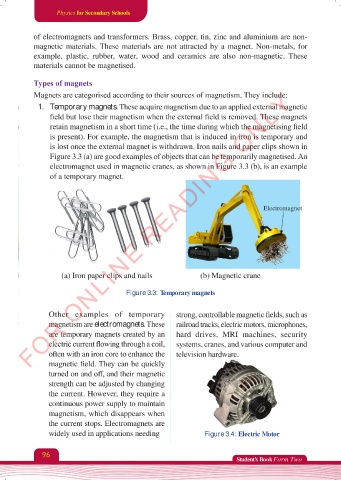
                is lost once the external magnet is withdrawn. Iron nails and paper clips shown in
                Figure 3.3 (a) are good examples of objects that can be temporarily magnetised. An
                electromagnet used in magnetic cranes, as shown in Figure 3.3 (b), is an example
                of a temporary magnet.


                                                                                 Electromagnet


                    (a) Iron paper clips and nails                (b) Magnetic crane

                                       Figure 3.3: Temporary magnets


                Other examples of temporary           strong, controllable magnetic fields, such as
                magnetism are electromagnets. These   railroad tracks, electric motors, microphones,
                are temporary magnets created by an   hard drives, MRI machines, security
                electric current flowing through a coil,   systems, cranes, and various computer and
                often with an iron core to enhance the   television hardware.
                magnetic field. They can be quickly
                turned on and off, and their magnetic
                strength can be adjusted by changing
                the current. However, they require a
                continuous power supply to maintain
                magnetism, which disappears when
                the current stops. Electromagnets are
                widely used in applications needing            Figure 3.4: Electric Motor


              96
                                                                         Student’s Book Form Two


     Physics Form 2 Final.indd   96                                                         25/10/2025   10:26

