


Page 100 - Physics_Form_2
P. 100
Physics for Secondary Schools


                           Chapter Three


                                          Magnetism

          FOR ONLINE READING ONLY


                Introduction

             Knowledge  of magnetism has provided  several  useful applications  in daily  life,
             starting from the historical navigation  by the  Greeks to the  present-day  digital
             world. In this chapter, you will learn the concept of magnetism and how materials
             can  be  magnetised  or  demagnetised.  You  will  also  learn  about  magnetic  fields,
             including the Earth’s magnetic field. The competencies developed will enable you
             to apply the knowledge of magnetism in various contexts.


                    Think
                        Life without the existence of magnetism


           Concept of magnetism                              The lodestone tends to attract

           Magnetism  is a  phenomenon  produced  by the     certain metals more strongly
           motion  of electric  charges that  results in an   at  specific  points  on  its  surface
           attractive and repulsive force between objects.   than others.  Any material that
           The  earliest  observation  of magnetism  was     has properties similar to those of
           recorded in 600 BC by the Greek philosopher       the lodestone is called a magnet.
           Thales. He observed that pieces of iron were      When magnets attract  or repel
           attracted  to a natural  mineral  iron ore called   each  other, they  exert  a force
           magnetite.  The lodestone is an example  of a     called magnetic force. Magnetism
           magnetised  piece  of  the  mineral  magnetite.   arises from two types of electron
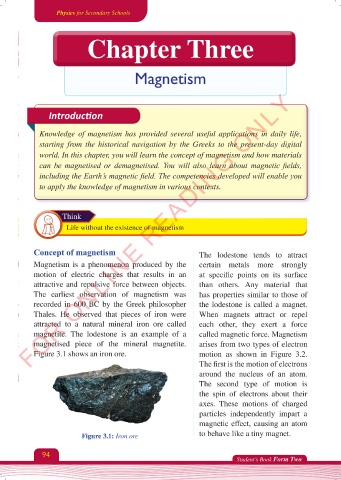
           Figure 3.1 shows an iron ore.                     motion as shown in Figure 3.2.
                                                             The first is the motion of electrons
                                                             around  the  nucleus  of  an  atom.
                                                             The second type of motion is
                                                             the spin of electrons about their
                                                             axes.  These motions  of charged
                                                             particles  independently  impart a
                                                             magnetic effect, causing an atom

                          Figure 3.1: Iron ore               to behave like a tiny magnet.

              94
                                                                         Student’s Book Form Two


     Physics Form 2 Final.indd   94                                                         25/10/2025   10:26

