


Page 125 - Physics_Form_2
P. 125
Magnetism

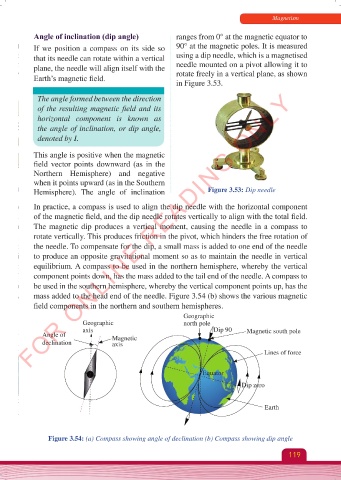
           Angle of inclination (dip angle)           ranges from 0° at the magnetic equator to
           If we position a compass on its side so    90° at the magnetic poles. It is measured
           that its needle can rotate within a vertical   using a dip needle, which is a magnetised
           plane, the needle will align itself with the   needle mounted on a pivot allowing it to
           Earth’s magnetic field.                    rotate freely in a vertical plane, as shown
                                                      in Figure 3.53.
          FOR ONLINE READING ONLY
            The angle formed between the direction
            of the resulting magnetic field and its
            horizontal component is known as
            the angle of inclination, or dip angle,
            denoted by I.

           This angle is positive when the magnetic
           field  vector  points  downward  (as  in  the
           Northern  Hemisphere)  and  negative
           when it points upward (as in the Southern
           Hemisphere).  The angle of inclination               Figure 3.53: Dip needle

           In practice, a compass is used to align the dip needle with the horizontal component
           of the magnetic field, and the dip needle rotates vertically to align with the total field.
           The magnetic dip produces a vertical moment, causing the needle in a compass to
           rotate vertically. This produces friction in the pivot, which hinders the free rotation of
           the needle. To compensate for the dip, a small mass is added to one end of the needle
           to produce an opposite gravitational moment so as to maintain the needle in vertical
           equilibrium. A compass to be used in the northern hemisphere, whereby the vertical
           component points down, has the mass added to the tail end of the needle. A compass to
           be used in the southern hemisphere, whereby the vertical component points up, has the
           mass added to the head end of the needle. Figure 3.54 (b) shows the various magnetic
           field components in the northern and southern hemispheres.
                                                         Geographic
                          Geographic                     north pole
                          axis                                    Dip 90    Magnetic south pole
              Angle of             Magnetic
              declination          axis
                                                                                 Lines of force


                                                              Equator
                                                                          Dip zero


                                                                                 Earth


                Figure 3.54: (a) Compass showing angle of declination (b) Compass showing dip angle

                                                                                        119


     Physics Form 2 Final.indd   119                                                        25/10/2025   10:27

