


Page 126 - Physics_Form_2
P. 126
Physics for Secondary Schools


           Use a compass and dip needle to determine        Exercise 3.4
           the angles of declination and inclination    1.  Briefly explain the following terms
           at your location.
                                                           as applied in magnetism.
                                                           (a)  A magnetic field.
           Applications  of  the  Earth’s  magnetic
           field                                           (b)  A magnetic line of force.
          FOR ONLINE READING ONLY
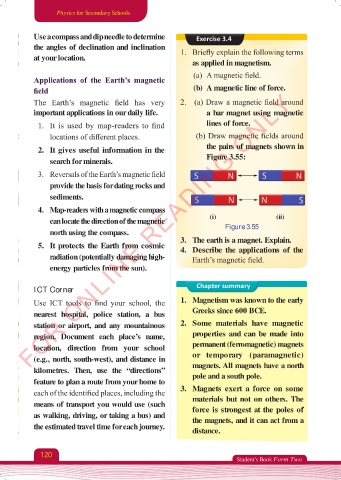
           The  Earth’s  magnetic  field  has  very     2.   (a) Draw a magnetic field around
           important applications in our daily life.           a bar magnet using magnetic

             1.  It is used by map-readers to find             lines of force.
                locations of different places.              (b) Draw magnetic fields around
             2.  It gives useful information in the            the pairs of magnets shown in
                search for minerals.                           Figure 3.55:

             3.  Reversals of the Earth’s magnetic field
                provide the basis for dating rocks and
                sediments.

             4.  Map-readers with a magnetic compass
                can locate the direction of the magnetic              (i)             (ii)
                north using the compass.                             Figure 3.55
                                                        3.  The earth is a magnet. Explain.
             5.  It protects the Earth from cosmic      4.  Describe  the  applications  of  the

                radiation (potentially damaging high-      Earth’s magnetic field.
                energy particles from the sun).


           ICT Corner                                       Chapter summary
           Use  ICT  tools  to  find  your  school,  the   1.  Magnetism was known to the early
           nearest  hospital,  police  station,  a bus     Greeks since 600 BCE.
           station or airport, and any mountainous      2.  Some materials have magnetic
           region.  Document  each  place’s name,          properties and can be made into

           location,  direction  from  your school         permanent (ferromagnetic) magnets
           (e.g., north, south-west), and distance in      or temporary (paramagnetic)
           kilometres.  Then, use the “directions”         magnets. All magnets have a north
           feature to plan a route from your home to       pole and a south pole.
           each of the identified places, including the   3.  Magnets  exert  a  force  on some
           means of transport you would use (such          materials but not on others. The
           as walking, driving, or taking a bus) and       force is strongest at the poles of
                                                           the magnets, and it can act from a
           the estimated travel time for each journey.     distance.


             120
                                                                         Student’s Book Form Two


     Physics Form 2 Final.indd   120                                                        25/10/2025   10:27

