


Page 139 - Physics_Form_2
P. 139
Nature and reflection of light

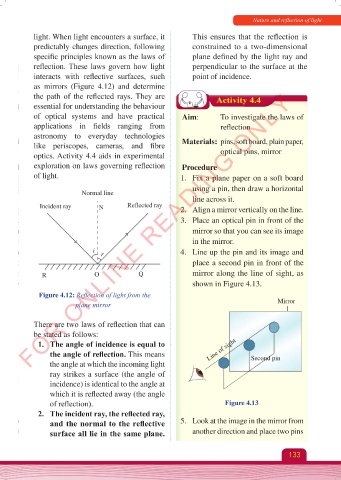
           light. When light encounters a surface, it      This ensures that the reflection is
           predictably changes direction, following        constrained to a two-dimensional
           specific principles known as the laws of        plane defined by the light ray and
           reflection. These laws govern how light         perpendicular to the surface at the
           interacts  with  reflective  surfaces,  such    point of incidence.
           as mirrors (Figure 4.12) and determine
          FOR ONLINE READING ONLY
           the  path  of  the  reflected  rays. They  are         Activity 4.4
           essential for understanding the behaviour
           of optical  systems and have practical       Aim:        To investigate the laws of
           applications  in  fields  ranging  from                  reflection
           astronomy to everyday technologies
           like  periscopes,  cameras,  and  fibre      Materials:  pins, soft board, plain paper,
           optics. Activity 4.4 aids in experimental                optical pins, mirror
           exploration on laws governing reflection     Procedure
           of light.                                    1.  Fix a plane paper on a soft board
                                                           using a pin, then draw a horizontal
                          Normal line
                                                           line across it.
             Incident ray      N        Reflected ray   2.  Align a mirror vertically on the line.
                                                        3.  Place an optical pin in front of the
                                                           mirror so that you can see its image
                                                           in the mirror.
                             i                          4.  Line up the pin and its image and
                                r
                                                           place a second pin in front of the

              R               O            Q               mirror along the line of sight, as
                                                           shown in Figure 4.13.

              Figure 4.12: Reflection of light from the
                                   plane mirror                                      Mirror

           There are two laws of reflection that can
           be stated as follows:
             1.  The angle of incidence is equal to
                the angle of reflection. This means             Line of sight  Second pin
                the angle at which the incoming light
                ray strikes a surface (the angle of
                incidence) is identical to the angle at
                which it is reflected away (the angle
                of reflection).                                      Figure 4.13
             2.  The incident ray, the reflected ray,
                and the normal to the reflective        5.  Look at the image in the mirror from
                surface all lie in the same plane.         another direction and place two pins


                                                                                        133


     Physics Form 2 Final.indd   133                                                        25/10/2025   10:27

