


Page 134 - Physics_Form_2
P. 134
Physics for Secondary Schools


             5.  Now, place a burning candle
                in front of board A and look
                through the hole in board
                C.  Then, move board B
                sideways slightly and again
                look through the pinhole in
          FOR ONLINE READING ONLY
                board C.

             Questions

              Focusing on observations in
              steps 4 and 5:
             (a) What insights did you gain
                from steps 4 and 5?
             (b) Draw patterns or themes from
                your observations in steps 4
                and 5.
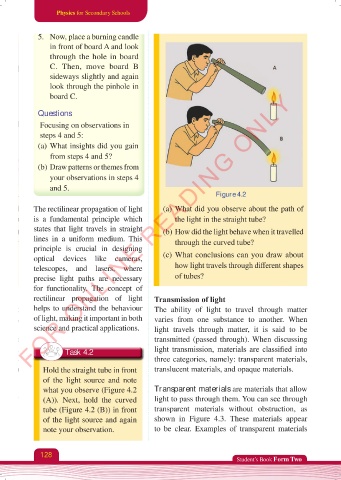
                                                                  Figure 4.2
           The rectilinear propagation of light   (a) What did you observe about the path of
           is a fundamental principle which           the light in the straight tube?
           states that light travels in straight   (b) How did the light behave when it travelled
           lines in a uniform medium.  This           through the curved tube?
           principle is crucial in designing
           optical devices like cameras,          (c) What conclusions can you draw about
           telescopes, and lasers, where              how light travels through different shapes
           precise light paths are necessary          of tubes?
           for functionality.  The concept of
           rectilinear propagation of light     Transmission of light
           helps to understand the behaviour    The ability  of light to travel through matter
           of light, making it important in both   varies from one substance to another.  When
           science and practical applications.  light travels through matter, it is said to be
                                                transmitted (passed through). When discussing

                     Task 4.2                   light transmission, materials are classified into
                                                three categories, namely: transparent materials,
              Hold the straight tube in front   translucent materials, and opaque materials.
              of  the  light  source  and  note
              what you observe (Figure 4.2      Transparent materials are materials that allow
              (A)).  Next, hold the curved      light to pass through them. You can see through
              tube (Figure 4.2 (B)) in front    transparent materials  without obstruction, as
              of the light source and again     shown  in Figure 4.3.  These materials  appear
              note your observation.            to be clear. Examples  of transparent  materials


             128
                                                                         Student’s Book Form Two


     Physics Form 2 Final.indd   128                                                        25/10/2025   10:27

