


Page 136 - Physics_Form_2
P. 136
Physics for Secondary Schools


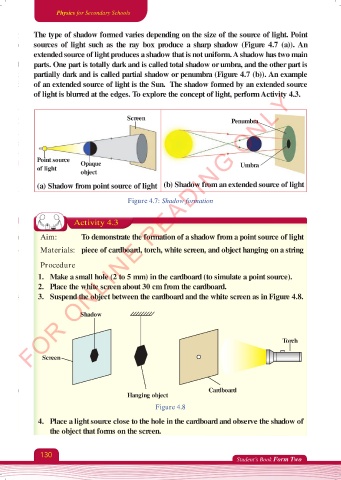
           The type of shadow formed varies depending on the size of the source of light. Point
           sources of light  such as the  ray  box  produce  a  sharp shadow (Figure  4.7  (a)). An
           extended source of light produces a shadow that is not uniform. A shadow has two main
           parts. One part is totally dark and is called total shadow or umbra, and the other part is
           partially dark and is called partial shadow or penumbra (Figure 4.7 (b)). An example
           of an extended source of light is the Sun.  The shadow formed by an extended source
          FOR ONLINE READING ONLY
           of light is blurred at the edges. To explore the concept of light, perform Activity 4.3.


                                       Screen                          Penumbra


            Point source   Opaque
            of light     object                                           Umbra

            (a) Shadow from point source of light  (b) Shadow from an extended source of light

                                        Figure 4.7: Shadow formation

                       Activity 4.3

             Aim:         To demonstrate the formation of a shadow from a point source of light
             Materials:   piece of cardboard, torch, white screen, and object hanging on a string

             Procedure
             1.  Make a small hole (2 to 5 mm) in the cardboard (to simulate a point source).
             2.  Place the white screen about 30 cm from the cardboard.
             3.  Suspend the object between the cardboard and the white screen as in Figure 4.8.

                         Shadow


                                                                                      Torch

              Screen


                                                                Cardboard
                                        Hanging object
                                                Figure 4.8
             4.  Place a light source close to the hole in the cardboard and observe the shadow of
                the object that forms on the screen.


             130
                                                                         Student’s Book Form Two


     Physics Form 2 Final.indd   130                                                        25/10/2025   10:27

