


Page 235 - Physics_Form_2
P. 235
Optical instruments

                                                      Structure of the human eye
                holding a camera. If you wish to
                take a picture of your own image,     The eye is nearly spherical and is about
                at what distance should you focus     2.5 cm in diameter. The front portion is
                your camera?                          somehow  more  sharply  curved  and  is

             3.  A lens camera is used to photograph a   covered by a tough, transparent membrane
          FOR ONLINE READING ONLY
                                                      called the cornea. The region behind the
                person who is 2.8 m tall and standing
                2.7 m in front of the camera. If the   cornea contains a liquid called aqueous
                                                      humour. Next to the  aqueous humour,
                film is placed 10 cm behind the lens,
                calculate the height of the produced   there is  a crystalline lens,  which is a
                                                      capsule containing a fibrous jelly, hard at
                image.
                                                      the centre and progressively softer at the
                                                      outer portions. The crystalline lens is held
           The human eye                              in place by ligaments that attach it to the

           The  human  eye  is  a  natural  optical   ciliary muscles which encircle the lens. In
           instrument that is exceptionally important   front of the lens, there is an aperture with
           for human life. It belongs to a general    a variable diameter known as the pupil.
           group of eyes found in nature called
           “camera-type  eyes” since the optical      The pupil’s size is controlled by the iris,
           behaviour of the eye is similar to that of a   which is attached to the ciliary muscles.
           lens camera. The human eye can respond     The iris is responsible for the colour of
           to a range of light frequencies. The human   the eye. It acts as the diaphragm in a lens
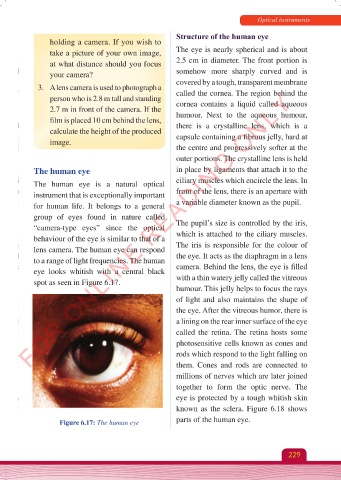
           eye looks whitish with a central  black    camera. Behind the lens, the eye is filled
           spot as seen in Figure 6.17.               with a thin watery jelly called the vitreous
                                                      humour. This jelly helps to focus the rays
                                                      of light and also maintains the shape of
                                                      the eye. After the vitreous humor, there is
                                                      a lining on the rear inner surface of the eye
                                                      called the retina. The retina hosts some
                                                      photosensitive cells known as cones and
                                                      rods which respond to the light falling on
                                                      them. Cones and rods are connected  to
                                                      millions of nerves which are later joined
                                                      together  to  form  the  optic  nerve.  The
                                                      eye is protected by a tough whitish skin
                                                      known as the sclera. Figure 6.18 shows

                   Figure 6.17: The human eye         parts of the human eye.


                                                                                        229


     Physics Form 2 Final.indd   229                                                        25/10/2025   10:28

