


Page 240 - Physics_Form_2
P. 240
Physics for Secondary Schools


           Note that lenses used for vision correction   Note that the myopic eye produces too
           are usually described in terms of lens        much convergence of light rays from a
           power, P, which is given by the reciprocal    distant  object,  while  a hyperopic  eye
           focal length expressed in metres. Hence,      produces  insufficient  convergence  of
                                                         rays of light from a near object.
                  1
             P =
          FOR ONLINE READING ONLY
                  f                                   Presbyopia
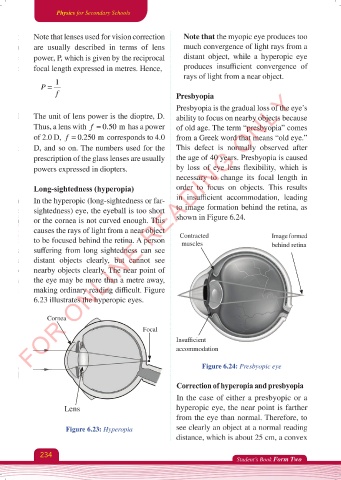
                                                      Presbyopia is the gradual loss of the eye’s
           The unit of lens power is the dioptre, D.   ability to focus on nearby objects because
           Thus, a lens with  f = 0.50 m  has a power   of old age. The term “presbyopia” comes
           of 2.0 D,  f =  0.250 m  corresponds to 4.0   from a Greek word that means “old eye.”
           D, and so on. The numbers used for the     This defect is normally observed after
           prescription of the glass lenses are usually   the age of 40 years. Presbyopia is caused
           powers expressed in diopters.              by  loss  of  eye  lens  flexibility,  which  is
                                                      necessary  to change  its focal  length  in

           Long-sightedness (hyperopia)               order to focus on objects.  This results
           In the hyperopic (long-sightedness or far-  in  insufficient  accommodation,  leading
           sightedness) eye, the eyeball is too short   to image formation behind the retina, as
           or the cornea is not curved enough. This   shown in Figure 6.24.
           causes the rays of light from a near object
           to be focused behind the retina. A person   Contracted                  Image formed
                                                        muscles
                                                                                   behind retina
           suffering from long sightedness can see
           distant objects clearly, but cannot see
           nearby objects clearly. The near point of
           the eye may be more than a metre away,
           making ordinary reading difficult. Figure
           6.23 illustrates the hyperopic eyes.

               Cornea
                                            Focal
                                                      Insufficient
                                                      accommodation

                                                              Figure 6.24: Presbyopic eye


                                                      Correction of hyperopia and presbyopia
                                                      In the case of either a presbyopic or a
                     Lens                             hyperopic eye, the near point is farther
                                                      from the eye than normal. Therefore, to
                     Figure 6.23: Hyperopia           see clearly an object at a normal reading
                                                      distance, which is about 25 cm, a convex

             234
                                                                         Student’s Book Form Two


     Physics Form 2 Final.indd   234                                                        25/10/2025   10:28

