


Page 236 - Physics_Form_2
P. 236
Physics for Secondary Schools


                                        Lens
                                                                     Sclera

                 Aqueous humour
                                                                        Retina


                 Cornea
                                                                             Optic nerve
          FOR ONLINE READING ONLY
                Pupil

                Iris

              Suspensory ligaments
                Ciliary muscle                                              Vitreous humour


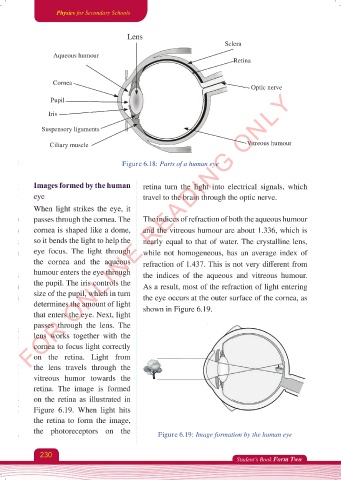
                                      Figure 6.18: Parts of a human eye


           Images formed by the human       retina turn the light into electrical  signals, which
           eye                              travel to the brain through the optic nerve.
           When light strikes the eye, it
           passes through the cornea. The   The indices of refraction of both the aqueous humour
           cornea is shaped like a dome,    and the vitreous humour are about 1.336, which is
           so it bends the light to help the   nearly equal to that of water. The crystalline lens,
           eye focus.  The light  through   while  not  homogeneous,  has  an  average  index  of
           the cornea and the aqueous       refraction of 1.437. This is not very different from
           humour enters the eye through    the  indices  of the  aqueous and vitreous  humour.
           the pupil. The iris controls the   As a result, most of the refraction of light entering
           size of the pupil, which in turn   the eye occurs at the outer surface of the cornea, as
           determines the amount of light   shown in Figure 6.19.
           that enters the eye. Next, light
           passes through the lens.  The
           lens works  together with the
           cornea to focus light correctly
           on the  retina.  Light  from
           the  lens  travels  through  the
           vitreous  humor  towards  the
           retina.  The image  is formed
           on the retina as illustrated in
           Figure  6.19.  When  light  hits
           the retina to form the image,
           the  photoreceptors  on the           Figure 6.19: Image formation by the human eye


             230
                                                                         Student’s Book Form Two


     Physics Form 2 Final.indd   230                                                        25/10/2025   10:28

