


Page 38 - Physics_Form_2
P. 38
Physics for Secondary Schools


                     Task 1.3

              Construct  a  proof plane  using
              materials  such as aluminium  foil,       Convective
                                                        clouds
              a small piece of cardboard, and a
          FOR ONLINE READING ONLY
              wooden stick.  Once  constructed,
              use the proof plane in conjunction
              with a leaf electroscope to determine                 Air currents
              the sign of the charge on a charged
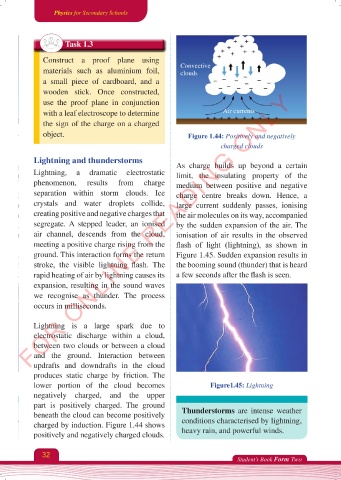
              object.                                     Figure 1.44: Positively and negatively

                                                                    charged clouds
           Lightning and thunderstorms                As charge  builds  up  beyond  a  certain

           Lightning,  a  dramatic  electrostatic     limit,  the  insulating  property  of the
           phenomenon,     results   from    charge   medium between positive and negative
           separation  within  storm clouds. Ice      charge centre breaks down.  Hence, a
           crystals  and water  droplets  collide,    large current suddenly passes, ionising
           creating positive and negative charges that   the air molecules on its way, accompanied
           segregate.  A stepped  leader, an ionised   by the sudden expansion of the air. The
           air channel, descends from the cloud,      ionisation  of air  results in the observed
           meeting a positive charge rising from the   flash  of  light  (lightning),  as  shown  in
           ground. This interaction forms the return   Figure 1.45. Sudden expansion results in
           stroke,  the  visible  lightning  flash.  The   the booming sound (thunder) that is heard
           rapid heating of air by lightning causes its   a few seconds after the flash is seen.
           expansion, resulting in the sound waves
           we recognise as thunder.  The process
           occurs in milliseconds.

           Lightning  is a large spark due to
           electrostatic  discharge within a cloud,
           between two clouds or between a cloud
           and the ground. Interaction between
           updrafts and downdrafts in the  cloud
           produces static  charge by friction.  The
           lower portion of the cloud becomes                    Figure1.45: Lightning
           negatively  charged, and the upper
           part  is positively  charged.  The  ground
           beneath the cloud can become positively      Thunderstorms are intense  weather
           charged by induction. Figure 1.44 shows      conditions characterised by lightning,
           positively and negatively charged clouds.    heavy rain, and powerful winds.


              32
                                                                         Student’s Book Form Two


     Physics Form 2 Final.indd   32                                                         25/10/2025   10:25

