


Page 34 - Physics_Form_2
P. 34
Physics for Secondary Schools
Solution
C 1 C 2 20 μF
V Using Equation (5);
C C C
1 2 3
FOR ONLINE READING ONLY
C = T C + 1 C 2
2 0 μF + 20 μF
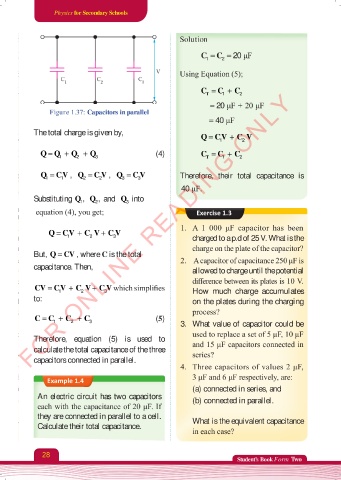
Figure 1.37: Capacitors in parallel
40 μF
The total charge is given by,
Q CV= 1 + C V
2
QQ= + Q + Q (4) C = C + C
1 2 3 T 1 2
Q = CV , Q = CV , Q = CV Therefore, their total capacitance is
1
3
3
2
2
1
40 μF.
Substituting Q 1 , Q 2 , and Q into
3
equation (4), you get; Exercise 1.3
1. A 1 000 μF capacitor has been
Q CV= + C V + C V
1 2 3 charged to a p.d of 25 V. What is the
charge on the plate of the capacitor?
But, Q CV= , where C is the total 2. A capacitor of capacitance 250 μF is
capacitance. Then, allowed to charge until the potential
difference between its plates is 10 V.
CV = CV + 1 C V + 2 C V which simplifies How much charge accumulates
3
to: on the plates during the charging
process?
C = C + 1 C + 2 C (5) 3. What value of capacitor could be
3
used to replace a set of 5 μF, 10 μF
Therefore, equation (5) is used to and 15 μF capacitors connected in
calculate the total capacitance of the three series?
capacitors connected in parallel.
4. Three capacitors of values 2 μF,
Example 1.4 3 μF and 6 μF respectively, are:
(a) connected in series, and
An electric circuit has two capacitors (b) connected in parallel.
each with the capacitance of 20 μF. If
they are connected in parallel to a cell. What is the equivalent capacitance
Calculate their total capacitance.
in each case?
28
Student’s Book Form Two
Physics Form 2 Final.indd 28 25/10/2025 10:25

