


Page 30 - Physics_Form_2
P. 30
Physics for Secondary Schools


                                                          capacitance can be varied is termed a
                                                          variable capacitor. On the other hand,
                                                          the capacitor whose capacitance
                                                          cannot be changed is a fixed capacitor.

                                                      Charging a capacitor
          FOR ONLINE READING ONLY
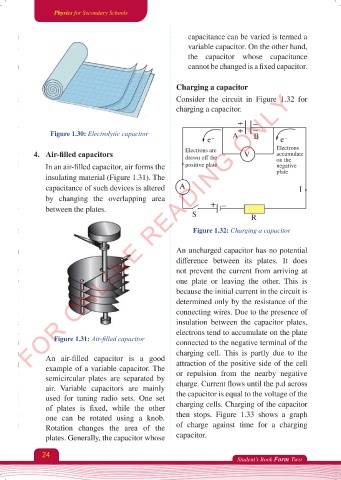
                                                      Consider the circuit  in Figure 1.32 for
                                                      charging a capacitor.


                Figure 1.30: Electrolytic capacitor                    A      B
                                                                e -                   e -

           4.   Air-filled capacitors                    Electrons are     V         Electrons
                                                                                     accumulate
                                                         drawn off the
                                                                                     on the
               In an air-filled capacitor, air forms the   positive plate            negative
                                                                                     plate
               insulating material (Figure 1.31). The
               capacitance of such devices is altered   A                                   I
               by changing the  overlapping area
               between the plates.
                                                           S                 R


                                                           Figure 1.32: Charging a capacitor

                                                      An uncharged capacitor has no potential
                                                      difference  between  its  plates.  It  does
                                                      not prevent the current from arriving at
                                                      one plate or leaving the other.  This is
                                                      because the initial current in the circuit is
                                                      determined only by the resistance of the
                                                      connecting wires. Due to the presence of
                                                      insulation  between  the  capacitor  plates,
                                                      electrons tend to accumulate on the plate
                 Figure 1.31: Air-filled capacitor    connected to the negative terminal of the

                                                      charging cell.  This is partly due to the
               An  air-filled  capacitor  is  a  good   attraction of the positive side of the cell
               example of a variable capacitor. The
               semicircular  plates are separated by   or  repulsion  from  the  nearby  negative
               air.  Variable capacitors  are mainly   charge. Current flows until the p.d across
               used for tuning radio sets. One set    the capacitor is equal to the voltage of the
               of  plates  is  fixed,  while  the  other   charging cells. Charging of the capacitor
               one can  be rotated  using a knob.     then  stops. Figure  1.33 shows a  graph
               Rotation  changes the area  of the     of charge against time for a charging
               plates. Generally, the capacitor whose   capacitor.

              24
                                                                         Student’s Book Form Two


     Physics Form 2 Final.indd   24                                                         25/10/2025   10:25

