


Page 25 - Physics_Form_2
P. 25
Static electricity


           2.   Identifying the insulating            at  the  specific  point.  Therefore,  there
                properties of materials               is  a  difference  in  electrostatic  potential
                An electroscope  that is positively   between any two points in the electrostatic
                charged can be used to test for the   force field.
                insulating properties of materials. If   Potential of a charged body
          FOR ONLINE READING ONLY
                the material that is placed near the
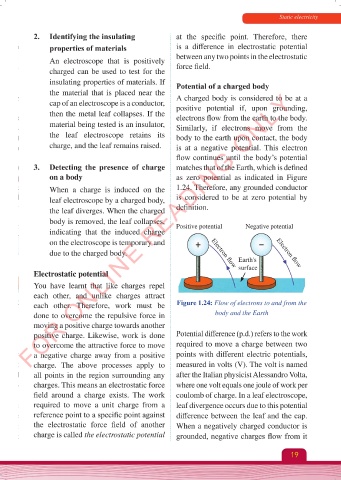
                cap of an electroscope is a conductor,   A charged body is considered to be at a
                                                      positive potential  if, upon grounding,
                then the metal leaf collapses. If the   electrons flow from the earth to the body.
                material being tested is an insulator,   Similarly, if electrons  move from the
                the leaf electroscope  retains its    body to the earth upon contact, the body
                charge, and the leaf remains raised.   is at a negative potential.  This electron

                                                      flow continues until the body’s potential
           3.   Detecting  the  presence  of  charge   matches that of the Earth, which is defined
                on a body                             as zero  potential  as indicated  in  Figure

                When  a  charge  is  induced  on  the   1.24. Therefore, any grounded conductor
                leaf electroscope by a charged body,   is  considered  to  be  at  zero  potential  by
                the leaf diverges. When the charged   definition.
                body is removed, the leaf collapses,   Positive potential  Negative potential
                indicating  that  the  induced charge
                on the electroscope is temporary and
                due to the charged body.                         Electron flow       Electron flow
                                                                         Earth's
                                                                         surface
           Electrostatic potential
           You have  learnt  that  like  charges repel
           each other, and unlike charges attract
           each other.  Therefore, work  must be      Figure 1.24: Flow of electrons to and from the
           done to overcome the repulsive force in                body and the Earth
           moving a positive charge towards another
           positive charge. Likewise, work is done    Potential difference (p.d.) refers to the work
           to overcome the attractive force to move   required to move a charge between two
           a negative charge away from a positive     points with different electric potentials,
           charge.  The  above  processes apply  to   measured in volts (V). The volt is named
           all points in the region surrounding any   after the Italian physicist Alessandro Volta,
           charges. This means an electrostatic force   where one volt equals one joule of work per
           field  around  a  charge  exists.  The  work   coulomb of charge. In a leaf electroscope,
           required  to move a unit charge from a     leaf divergence occurs due to this potential
           reference point to a specific point against   difference between the leaf and the cap.
           the  electrostatic  force  field  of  another   When a negatively charged conductor is
           charge is called the electrostatic potential   grounded, negative charges flow from it


                                                                                         19


     Physics Form 2 Final.indd   19                                                         25/10/2025   10:25

