


Page 20 - Physics_Form_2
P. 20
Physics for Secondary Schools


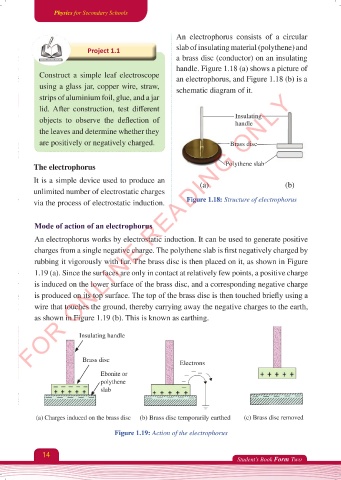
                                                      An electrophorus consists of a circular

                            Project 1.1               slab of insulating material (polythene) and
                                                      a brass disc (conductor) on an insulating
                                                      handle. Figure 1.18 (a) shows a picture of
             Construct  a simple  leaf  electroscope   an electrophorus, and Figure 1.18 (b) is a
             using a glass jar, copper wire, straw,   schematic diagram of it.
          FOR ONLINE READING ONLY
             strips of aluminium foil, glue, and a jar

             lid. After  construction,  test  different
             objects  to  observe  the  deflection  of                  Insulating
                                                                        handle
             the leaves and determine whether they
             are positively or negatively charged.                     Brass disc


           The electrophorus                                         Polythene slab

           It is a simple device used to produce an          (a)                               (b)
           unlimited number of electrostatic charges
           via the process of electrostatic induction.   Figure 1.18: Structure of electrophorus


           Mode of action of an electrophorus
           An electrophorus works by electrostatic induction. It can be used to generate positive
           charges from a single negative charge. The polythene slab is first negatively charged by
           rubbing it vigorously with fur. The brass disc is then placed on it, as shown in Figure
           1.19 (a). Since the surfaces are only in contact at relatively few points, a positive charge

           is induced on the lower surface of the brass disc, and a corresponding negative charge
           is produced on its top surface. The top of the brass disc is then touched briefly using a
           wire that touches the ground, thereby carrying away the negative charges to the earth,
           as shown in Figure 1.19 (b). This is known as earthing.

                         Insulating handle


                          Brass disc                   Electrons

                               Ebonite or
                               polythene
                               slab


            (a) Charges induced on the brass disc  (b) Brass disc temporarily earthed  (c) Brass disc removed

                                    Figure 1.19: Action of the electrophorus


              14
                                                                         Student’s Book Form Two


     Physics Form 2 Final.indd   14                                                         25/10/2025   10:25

