


Page 17 - Physics_Form_2
P. 17
Static electricity


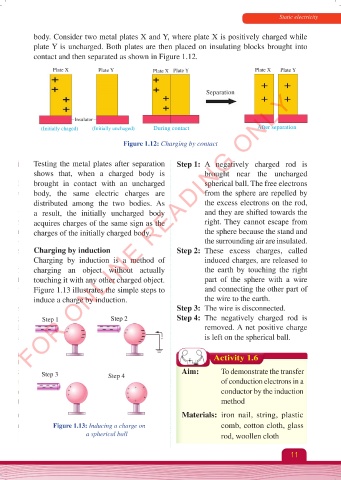
           body. Consider two metal plates X and Y, where plate X is positively charged while
           plate Y is uncharged. Both plates are then placed on insulating blocks brought into
           contact and then separated as shown in Figure 1.12.
                 Plate X       Plate Y         Plate X Plate Y                Plate X   Plate Y


          FOR ONLINE READING ONLY
                                                               Separation


                        Insulator
             (Initially chaged)  (Initially unchaged)  During contact          After separation
                                      Figure 1.12: Charging by contact


           Testing the metal plates after separation   Step 1:  A negatively  charged rod is
           shows that,  when a  charged body is                brought  near  the  uncharged
           brought in contact with an uncharged                spherical ball. The free electrons
           body, the same electric charges are                 from the sphere are repelled by
           distributed  among  the  two bodies.  As            the excess electrons on the rod,
           a result, the initially  uncharged body             and they are shifted towards the
           acquires charges of the same sign as the            right. They cannot escape from
           charges of the initially charged body.              the sphere because the stand and
                                                               the surrounding air are insulated.
           Charging by induction                      Step 2:  These  excess  charges, called
           Charging  by induction  is  a  method  of           induced charges, are released to
           charging an object  without actually                the earth by touching the right
           touching it with any other charged object.          part  of the  sphere  with  a wire
           Figure 1.13 illustrates the simple steps to         and connecting the other part of
           induce a charge by induction.                       the wire to the earth.
                                                      Step 3:  The wire is disconnected.
              Step 1               Step 2             Step 4:  The  negatively  charged  rod  is
                                                               removed. A net positive charge
                                                               is left on the spherical ball.

                                                                  Activity 1.6


              Step 3              Step 4                Aim:        To demonstrate the transfer
                                                                    of conduction electrons in a
                                                                    conductor by the induction
                                                                    method
                                                        Materials:  iron nail, string, plastic

                 Figure 1.13: Inducing a charge on                  comb, cotton cloth, glass
                                a spherical ball                    rod, woollen cloth


                                                                                         11


     Physics Form 2 Final.indd   11                                                         25/10/2025   10:25

