


Page 12 - Physics_Form_2
P. 12
Physics for Secondary Schools


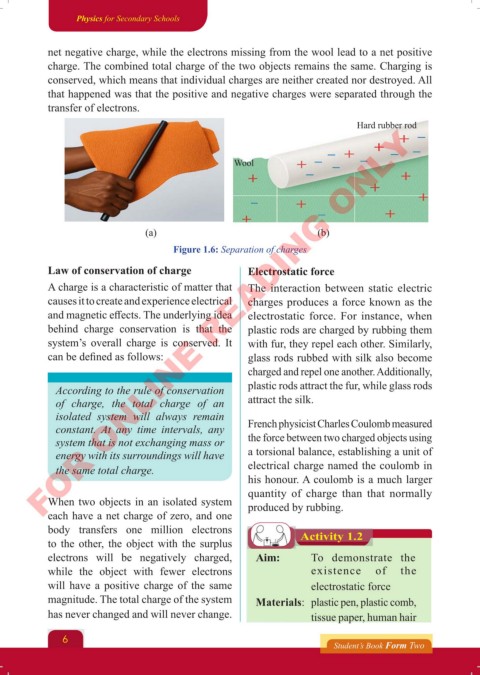
           net negative charge, while the electrons missing from the wool lead to a net positive
           charge. The combined total charge of the two objects remains the same. Charging is
           conserved, which means that individual charges are neither created nor destroyed. All
           that happened was that the positive and negative charges were separated through the
           transfer of electrons.

                                                                              Hard rubber rod
          FOR ONLINE READING ONLY

                                                   Wool


                                      (a)                                                               (b)

                                      Figure 1.6: Separation of charges
           Law of conservation of charge              Electrostatic force

           A charge is a characteristic of matter that   The interaction between static electric
           causes it to create and experience electrical   charges produces a force known as the
           and magnetic effects. The underlying idea   electrostatic force. For instance, when
           behind charge conservation is that  the    plastic rods are charged by rubbing them
           system’s overall charge is conserved. It   with fur, they repel each other. Similarly,
           can be defined as follows:                 glass rods rubbed with silk also become
                                                      charged and repel one another. Additionally,
             According to the rule of conservation    plastic rods attract the fur, while glass rods
             of  charge,  the  total  charge  of  an   attract the silk.
             isolated  system will  always remain
             constant.  At any time intervals, any    French physicist Charles Coulomb measured
             system that is not exchanging mass or    the force between two charged objects using
             energy with its surroundings will have   a torsional balance, establishing a unit of
             the same total charge.                   electrical charge named the coulomb in
                                                      his honour. A coulomb is a much larger
                                                      quantity of charge than that normally
           When two objects in an isolated system     produced by rubbing.
           each have a net charge of zero, and one
           body  transfers  one  million  electrons               Activity 1.2
           to the other, the object with the surplus
           electrons will be negatively charged,        Aim:        To demonstrate the
           while the object  with fewer electrons                   existence of the
           will have a positive charge of the same                  electrostatic force
           magnitude. The total charge of the system    Materials:   plastic pen, plastic comb,
           has never changed and will never change.                 tissue paper, human hair

              6
                                                                         Student’s Book Form Two


     Physics Form 2 Final.indd   6                                                          25/10/2025   10:25

