


Page 11 - Physics_Form_2
P. 11
Static electricity


                Example 1.1                             (ii)
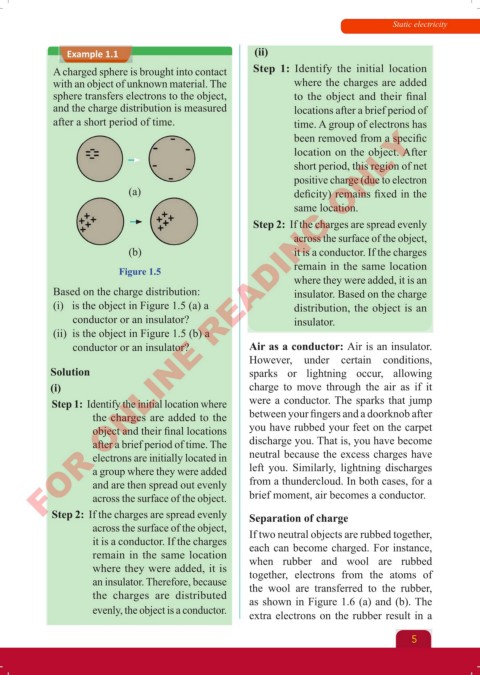
            A charged sphere is brought into contact   Step 1: Identify the initial location
            with an object of unknown material. The             where the charges are added
            sphere transfers electrons to the object,           to the object and their final
            and the charge distribution is measured             locations after a brief period of
            after a short period of time.                       time. A group of electrons has
          FOR ONLINE READING ONLY
                                                                been removed from a specific
                                                                location on the object. After
                                                                short period, this region of net
                                                                positive charge (due to electron
                               (a)                              deficity) remains fixed in the
                                                                same location.
                                                       Step 2:  If the charges are spread evenly
                                                                across the surface of the object,
                               (b)                              it is a conductor. If the charges
                                                                remain in the same location
                           Figure 1.5
                                                                where they were added, it is an
            Based on the charge distribution:                   insulator. Based on the charge
            (i)   is the object in Figure 1.5 (a) a             distribution, the object is an
                   conductor or an insulator?                   insulator.
            (ii)  is the object in Figure 1.5 (b) a
                   conductor or an insulator?          Air as a conductor: Air is an insulator.
                                                       However, under certain conditions,
            Solution                                   sparks or lightning  occur, allowing
            (i)                                        charge to move through the air as if it
            Step 1:  Identify the initial location where   were a conductor. The sparks that jump
                     the charges are added to the      between your fingers and a doorknob after
                     object and their final locations   you have rubbed your feet on the carpet
                     after a brief period of time. The   discharge you. That is, you have become
                     electrons are initially located in   neutral because the excess charges have
                     a group where they were added     left you. Similarly, lightning discharges
                     and are then spread out evenly    from a thundercloud. In both cases, for a
                     across the surface of the object.  brief moment, air becomes a conductor.
            Step 2:  If the charges are spread evenly   Separation of charge
                     across the surface of the object,   If two neutral objects are rubbed together,
                     it is a conductor. If the charges   each can become charged. For instance,
                     remain in the same location       when rubber and wool are rubbed
                     where they were added, it is      together, electrons from the  atoms of
                     an insulator. Therefore, because   the  wool are transferred  to the  rubber,
                     the charges are distributed       as shown in Figure 1.6 (a) and (b). The
                     evenly, the object is a conductor.  extra electrons on the rubber result in a


                                                                                          5


     Physics Form 2 Final.indd   5                                                          25/10/2025   10:25

