


Page 8 - Physics_Form_2
P. 8
Physics for Secondary Schools


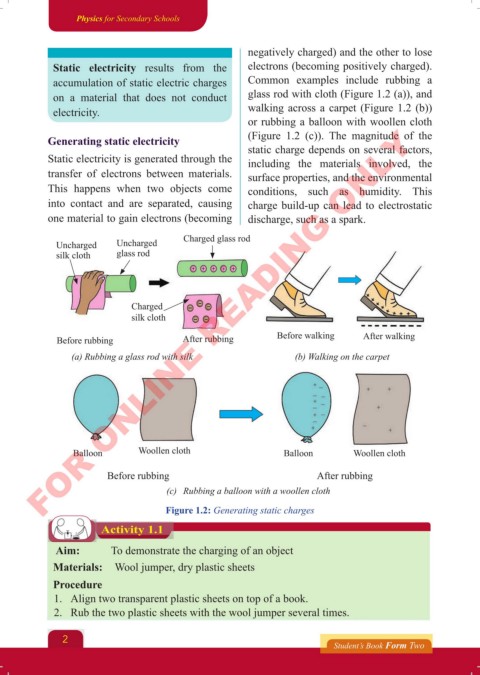
                                                      negatively charged) and the other to lose
            Static electricity  results from the      electrons (becoming positively charged).
            accumulation of static electric charges   Common  examples  include  rubbing  a
            on a material  that  does not conduct     glass rod with cloth (Figure 1.2 (a)), and
            electricity.                              walking across a carpet (Figure 1.2 (b))
                                                      or rubbing a balloon with woollen cloth
          FOR ONLINE READING ONLY
           Generating static electricity              (Figure  1.2 (c)).  The  magnitude  of the
                                                      static charge depends on several factors,
           Static electricity is generated through the   including  the materials  involved,  the
           transfer of electrons between materials.   surface properties, and the environmental
           This happens when two objects come         conditions, such as humidity.  This
           into  contact  and  are  separated,  causing   charge build-up can lead to electrostatic
           one material to gain electrons (becoming   discharge, such as a spark.


             Uncharged    Uncharged     Charged glass rod
             silk cloth   glass rod


                             Charged
                             silk cloth

             Before rubbing             After rubbing        Before walking    After walking
                  (a) Rubbing a glass rod with silk                     (b) Walking on the carpet


                 Balloon       Woollen cloth                  Balloon        Woollen cloth

                        Before rubbing                                                          After rubbing
                                     (c)  Rubbing a balloon with a woollen cloth

                                     Figure 1.2: Generating static charges
                       Activity 1.1

             Aim:        To demonstrate the charging of an object
            Materials:   Wool jumper, dry plastic sheets

            Procedure
             1.  Align two transparent plastic sheets on top of a book.
             2.  Rub the two plastic sheets with the wool jumper several times.


              2
                                                                         Student’s Book Form Two


     Physics Form 2 Final.indd   2                                                          25/10/2025   10:25

