


Page 15 - Physics_Form_2
P. 15
Static electricity


           Charging objects                           Mechanism of charging by friction
           A neutral object has the same number of    When two insulating materials  are
           positive and negative  charges, so they    rubbed together, friction generates an
           balance each other out. When you bring     imbalance of electric charges. Electrons,
           another neutral object close to it or touch   which  are  negatively  charged  particles,
           them together, nothing special  usually    are transferred from one object  to
          FOR ONLINE READING ONLY
           happens because both objects  have         another.  The  object  that  loses electrons
           balanced charges.                          becomes positively  charged, while the

                                                      object  that  gains  electrons becomes
           However, if something causes one of the    negatively  charged.  This transfer  of
           objects to have more positive or negative   charge is governed by the principle  of
           charges than the other, this is called     conservation of charge, meaning that the
           an imbalance  of charges. Creating  this   total charge before and after the rubbing
           imbalance is known as charging an object.
                                                      process  remains  constant.  For example,
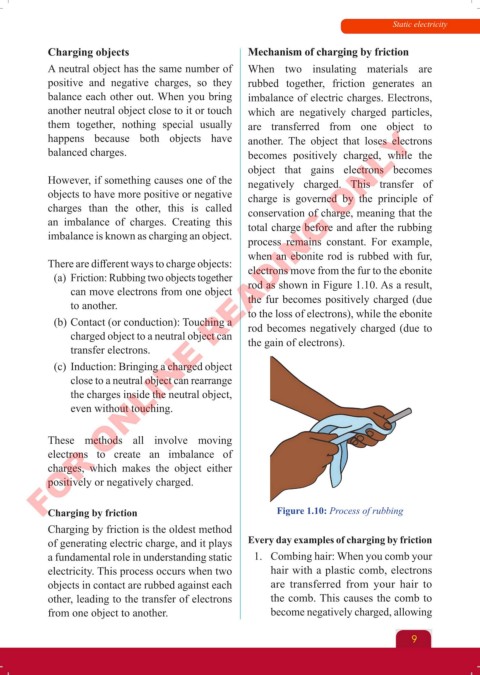
                                                      when an ebonite rod is rubbed with fur,
           There are different ways to charge objects:  electrons move from the fur to the ebonite
             (a) Friction: Rubbing two objects together
                can move electrons from one object    rod as shown in Figure 1.10. As a result,
                to another.                           the fur becomes positively charged (due
             (b) Contact (or conduction): Touching a   to the loss of electrons), while the ebonite
                                                      rod becomes negatively charged (due to
                charged object to a neutral object can   the gain of electrons).
                transfer electrons.
             (c) Induction: Bringing a charged object
                close to a neutral object can rearrange
                the charges inside the neutral object,
                even without touching.


           These methods all involve moving
           electrons to create  an imbalance  of
           charges, which makes the object  either
           positively or negatively charged.


           Charging by friction                              Figure 1.10: Process of rubbing
           Charging by friction is the oldest method
           of generating electric charge, and it plays   Every day examples of charging by friction
           a fundamental role in understanding static   1.  Combing hair: When you comb your
           electricity. This process occurs when two       hair with a plastic comb, electrons
           objects in contact are rubbed against each      are transferred from your hair to
           other, leading to the transfer of electrons     the comb. This causes the comb to
           from one object to another.                     become negatively charged, allowing


                                                                                          9


     Physics Form 2 Final.indd   9                                                          25/10/2025   10:25

