


Page 22 - Physics_Form_2
P. 22
Physics for Secondary Schools


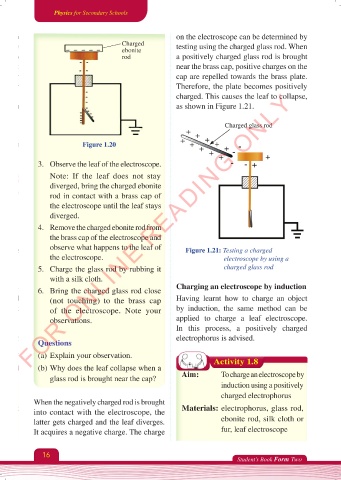
                                                      on the electroscope can be determined by
                                      Charged         testing using the charged glass rod. When
                                      ebonite
                                      rod             a positively charged glass rod is brought
                                                      near the brass cap, positive charges on the
                                                      cap are repelled towards the brass plate.
                                                      Therefore, the plate becomes positively
          FOR ONLINE READING ONLY
                                                      charged. This causes the leaf to collapse,
                                                      as shown in Figure 1.21.


                                                                     Charged glass rod

                          Figure 1.20


             3.  Observe the leaf of the electroscope.
                Note:  If  the  leaf  does  not  stay
                diverged, bring the charged ebonite
                rod in contact with a brass cap of
                the electroscope until the leaf stays
                diverged.
             4.  Remove the charged ebonite rod from
                the brass cap of the electroscope and
                observe what happens to the leaf of      Figure 1.21: Testing a charged
                the electroscope.                                    electroscope by using a
             5.  Charge the glass rod by rubbing it                  charged glass rod
                with a silk cloth.
             6.  Bring the charged glass rod close    Charging an electroscope by induction
                (not  touching)  to  the  brass  cap   Having  learnt  how to  charge  an  object
                of the electroscope. Note your        by induction, the same method can be
                observations.                         applied  to  charge  a  leaf  electroscope.
                                                      In this process, a positively  charged
                                                      electrophorus is advised.
             Questions
             (a) Explain your observation.                        Activity 1.8
             (b) Why does the leaf collapse when a
                glass rod is brought near the cap?      Aim:        To charge an electroscope by
                                                                    induction using a positively
                                                                    charged electrophorus
           When the negatively charged rod is brought
           into contact with the electroscope, the      Materials: electrophorus, glass rod,
           latter gets charged and the leaf diverges.               ebonite rod, silk cloth or
           It acquires a negative charge. The charge                fur, leaf electroscope


              16
                                                                         Student’s Book Form Two


     Physics Form 2 Final.indd   16                                                         25/10/2025   10:25

