


Page 23 - Physics_Form_2
P. 23
Static electricity


            Procedure
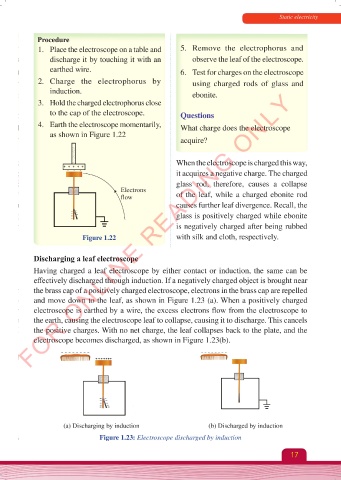
             1.  Place the electroscope on a table and   5.  Remove the electrophorus and
                discharge it by touching it with an        observe the leaf of the electroscope.
                earthed wire.                           6.  Test for charges on the electroscope
             2.  Charge the electrophorus by               using charged rods of glass and
          FOR ONLINE READING ONLY
                induction.                                 ebonite.
             3.  Hold the charged electrophorus close
                to the cap of the electroscope.         Questions
             4.  Earth the electroscope momentarily,    What charge does the electroscope
                as shown in Figure 1.22
                                                        acquire?


                                                      When the electroscope is charged this way,
                                                      it acquires a negative charge. The charged
                                                      glass rod, therefore,  causes a collapse
                                      Electrons
                                      flow            of the leaf, while a charged ebonite rod
                                                      causes further leaf divergence. Recall, the
                                                      glass is positively charged while ebonite
                                                      is negatively charged after being rubbed
                          Figure 1.22                 with silk and cloth, respectively.


           Discharging a leaf electroscope
           Having charged a leaf electroscope by either contact or induction, the same can be
           effectively discharged through induction. If a negatively charged object is brought near
           the brass cap of a positively charged electroscope, electrons in the brass cap are repelled
           and move down to the leaf, as shown in Figure 1.23 (a). When a positively charged
           electroscope is earthed by a wire, the excess electrons flow from the electroscope to
           the earth, causing the electroscope leaf to collapse, causing it to discharge. This cancels
           the positive charges. With no net charge, the leaf collapses back to the plate, and the
           electroscope becomes discharged, as shown in Figure 1.23(b).


                             (a) Discharging by induction              (b) Discharged by induction
                               Figure 1.23: Electroscope discharged by induction

                                                                                         17


     Physics Form 2 Final.indd   17                                                         25/10/2025   10:25

