


Page 28 - Physics_Form_2
P. 28
Physics for Secondary Schools
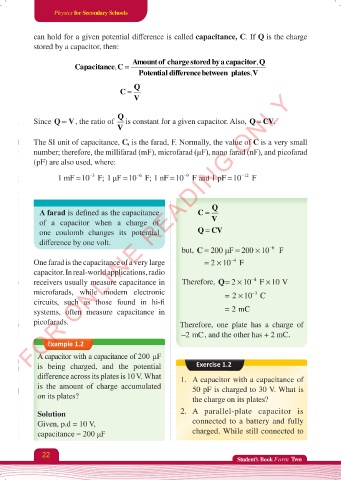
can hold for a given potential difference is called capacitance, C. If Q is the charge
stored by a capacitor, then:
Amount of charge stored by acapacitor ,Q
Capacitance ,C =
Potential differencebetween plates ,V
C = Q
FOR ONLINE READING ONLY
V
Q
Since Q , the ratio of is constant for a given capacitor. Also, Q CV= .
V
V
The SI unit of capacitance, C, is the farad, F. Normally, the value of C is a very small
number; therefore, the millifarad (mF), microfarad (μF), nano farad (nF), and picofarad
(pF) are also used, where:
1 mF 10 F; 3 1 μF 10 6 F; 1 nF 10 9 F and 1 pF 10 12 F
Q
A farad is defined as the capacitance C =
of a capacitor when a charge of V
one coulomb changes its potential Q CV=
difference by one volt.
but, C 200 μF 200 10 6 F
2 10
One farad is the capacitance of a very large 4 F
capacitor. In real-world applications, radio
receivers usually measure capacitance in Therefore, Q 4
2 10 F 10 V
microfarads, while modern electronic = 2 10 C 3
circuits, such as those found in hi-fi
systems, often measure capacitance in = 2 mC
picofarads. Therefore, one plate has a charge of
2 mC, and the other has + 2 mC.
Example 1.2
A capacitor with a capacitance of 200 μF
is being charged, and the potential Exercise 1.2
difference across its plates is 10 V. What 1. A capacitor with a capacitance of
is the amount of charge accumulated 50 pF is charged to 30 V. What is
on its plates? the charge on its plates?
Solution 2. A parallel-plate capacitor is
Given, p.d = 10 V, connected to a battery and fully
capacitance = 200 μF charged. While still connected to
22
Student’s Book Form Two
Physics Form 2 Final.indd 22 25/10/2025 10:25

