


Page 32 - Physics_Form_2
P. 32
Physics for Secondary Schools


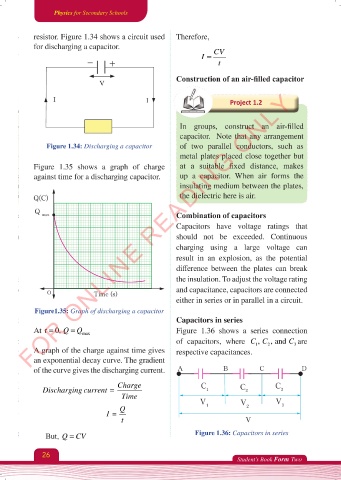
           resistor. Figure 1.34 shows a circuit used   Therefore,
           for discharging a capacitor.
                                                              I =  CV
                                                                   t

                                                      Construction of an air-filled capacitor
                               V
          FOR ONLINE READING ONLY
                 I                           I                         Project 1.2


                                                       In  groups,  construct  an  air-filled
                                                       capacitor.  Note that any arrangement
               Figure 1.34: Discharging a capacitor    of two parallel conductors, such as
                                                       metal plates placed close together but
           Figure 1.35 shows a graph of charge         at  a  suitable  fixed  distance,  makes
           against time for a discharging capacitor.   up  a  capacitor.  When  air  forms  the
                                                       insulating medium between the plates,
                                                       the dielectric here is air.
           Q(C)
            Q
              max                                     Combination of capacitors
                                                      Capacitors  have  voltage  ratings  that
                                                      should not be exceeded. Continuous
                                                      charging  using  a  large  voltage  can
                                                      result in an explosion, as the potential
                                                      difference  between  the  plates  can  break
                                                      the insulation. To adjust the voltage rating
                                                      and capacitance, capacitors are connected
               O             Time (s)
                                                      either in series or in parallel in a circuit.
            Figure1.35: Graph of discharging a capacitor
                                                      Capacitors in series
           At t =  0, QQ=  max                        Figure 1.36 shows  a series connection
                                                                               ,
                                                      of capacitors,  where  CC   2 , and C are
                                                                              1
                                                                                          3
           A graph of the charge against time gives   respective capacitances.
           an exponential decay curve. The gradient
           of the curve gives the discharging current.  A            B          C           D

                                     Charge                   C                     C
              Discharging current =                            1          C 2         3
                                      Time
                                                              V           V         V
                                     Q                         1            2         3
                                 I=
                                      t                                    V

                 But, Q CV=                                 Figure 1.36: Capacitors in series


              26
                                                                         Student’s Book Form Two


     Physics Form 2 Final.indd   26                                                         25/10/2025   10:25

