


Page 36 - Physics_Form_2
P. 36
Physics for Secondary Schools


           Charge distribution on a conductor
           Induced charge resides on the  surface of a conductor. Conductors appear  in many
           different  shapes,  such  as  spherical,  pear-shaped  and  cylindrical  surfaces.  Charge
           distribution on conductors depends on the shape of the conductor.


           Charge distribution on the surface of a conductor
          FOR ONLINE READING ONLY
           The distribution of charges on a conductor depends on the shape of the conductor.
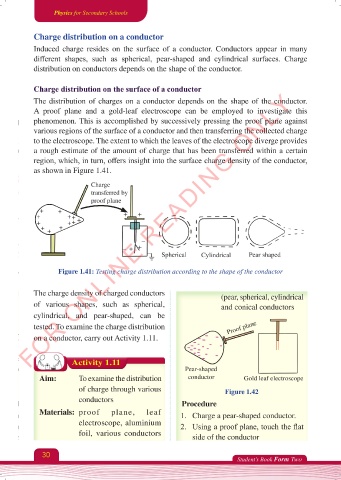
           A  proof plane  and a  gold-leaf  electroscope  can be employed  to investigate  this
           phenomenon. This is accomplished by successively pressing the proof plane against
           various regions of the surface of a conductor and then transferring the collected charge
           to the electroscope. The extent to which the leaves of the electroscope diverge provides
           a rough estimate of the amount of charge that has been transferred within a certain
           region, which, in turn, offers insight into the surface charge density of the conductor,
           as shown in Figure 1.41.

                             Charge
                             transferred by
                             proof plane
             +     +
            +        ++  +            +    +
            +        + +
             +  +  +

                                            –
                                      –  +  +
                                                  Spherical   Cylindrical   Pear shaped

                   Figure 1.41: Testing charge distribution according to the shape of the conductor


           The charge density of charged conductors                 (pear, spherical, cylindrical
           of various shapes, such as spherical,                    and conical conductors
           cylindrical,  and pear-shaped, can be

           tested. To examine the charge distribution                 Proof plane
           on a conductor, carry out Activity 1.11.


                       Activity 1.11
                                                         Pear-shaped
             Aim:        To examine the distribution      conductor        Gold leaf electroscope
                         of charge through various                   Figure 1.42
                         conductors                     Procedure

             Materials:  proof     plane,    leaf       1.  Charge a pear-shaped conductor.
                         electroscope, aluminium        2.  Using a proof plane, touch the flat
                         foil,  various  conductors        side of the conductor


              30
                                                                         Student’s Book Form Two


     Physics Form 2 Final.indd   30                                                         25/10/2025   10:25

