


Page 66 - Physics_Form_2
P. 66
Physics for Secondary Schools
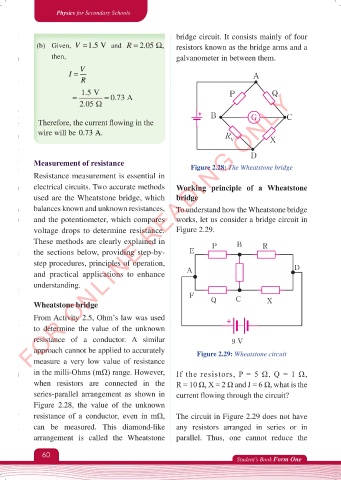
bridge circuit. It consists mainly of four
(b) Given, V = 1.5 V and R 2.05 , resistors known as the bridge arms and a
then, galvanometer in between them.
V
I = A
R
FOR ONLINE READING ONLY
1.5 V Q
0.73 A P
2.05
B C
Therefore, the current flowing in the
wire will be 0.73 A. R
V X
D
Measurement of resistance
Figure 2.28: The Wheatstone bridge
Resistance measurement is essential in
electrical circuits. Two accurate methods Working principle of a Wheatstone
used are the Wheatstone bridge, which bridge
balances known and unknown resistances, To understand how the Wheatstone bridge
and the potentiometer, which compares works, let us consider a bridge circuit in
voltage drops to determine resistance. Figure 2.29.
These methods are clearly explained in P B R
the sections below, providing step-by- E
step procedures, principles of operation, D
and practical applications to enhance A
understanding.
F C
Wheatstone bridge Q X
From Activity 2.5, Ohm’s law was used
to determine the value of the unknown
resistance of a conductor. A similar 9 V
approach cannot be applied to accurately Figure 2.29: Wheatstone circuit
measure a very low value of resistance
in the milli-Ohms (mΩ) range. However, If the resistors, P = 5 Ω, Q = 1 Ω,
when resistors are connected in the R = 10 Ω, X = 2 Ω and J = 6 Ω, what is the
series-parallel arrangement as shown in current flowing through the circuit?
Figure 2.28, the value of the unknown
resistance of a conductor, even in mΩ, The circuit in Figure 2.29 does not have
can be measured. This diamond-like any resistors arranged in series or in
arrangement is called the Wheatstone parallel. Thus, one cannot reduce the
60
Student’s Book Form One
Physics Form 2 Final.indd 60 25/10/2025 10:26

