


Page 64 - Physics_Form_2
P. 64
Physics for Secondary Schools
micrometer screw gauge, Questions
a constantan wire of length
20 cm (a) What happened to the potential
Procedure difference as the current was
increased?
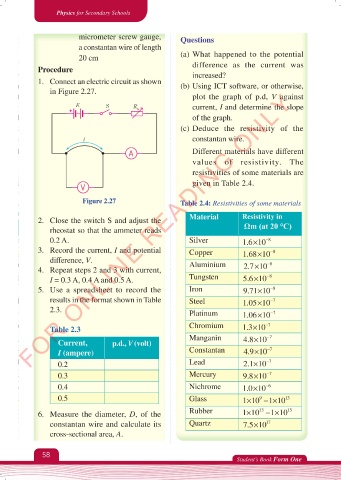
1. Connect an electric circuit as shown (b) Using ICT software, or otherwise,
FOR ONLINE READING ONLY
in Figure 2.27.
plot the graph of p.d, V against
E S R h current, I and determine the slope
of the graph.
(c) Deduce the resistivity of the
l constantan wire.
Different materials have different
values of resistivity. The
resistivities of some materials are
given in Table 2.4.
Figure 2.27 Table 2.4: Resistivities of some materials
2. Close the switch S and adjust the Material Resistivity in
rheostat so that the ammeter reads Ωm (at 20 °C)
0.2 A. Silver 1.6 10 8
3. Record the current, I and potential Copper 1.68 10 8
difference, V. Aluminium 8
4. Repeat steps 2 and 3 with current, 2.7 10
I = 0.3 A, 0.4 A and 0.5 A. Tungsten 5.6 10 8
5. Use a spreadsheet to record the Iron 9.71 10 8
results in the format shown in Table Steel 1.05 10 7
2.3. Platinum 1.06 10 7
Table 2.3 Chromium 1.3 10 7
Manganin 4.8 10 7
Current, p.d., V (volt)
I (ampere) Constantan 4.9 10 7
0.2 Lead 2.1 10 7
0.3 Mercury 9.8 10 7
0.4 Nichrome 1.0 10 6
0.5 Glass 1 10 9 13
1 10
1 10
6. Measure the diameter, D, of the Rubber 1 10 13 15
constantan wire and calculate its Quartz 7.5 10 17
cross-sectional area, A.
58
Student’s Book Form One
Physics Form 2 Final.indd 58 25/10/2025 10:26

