


Page 87 - Physics_Form_2
P. 87
Current electricity
time when zinc ions go into solution, an Mode of action of a dry cell (Leclanché
equivalent number of hydrogen ions move cell)
to the copper electrode where they gain The Leclanché cell consists of carbon as
electrons and are liberated as hydrogen a positive electrode and zinc as a negative
gas (bubbles):
electrode. The electrolyte in this cell
FOR ONLINE READING ONLY
2H 2e Hg is ammonium chloride (NH Cl) (Sal-
()
4
2
ammoniac)
By losing electrons, copper becomes
positively charged and enables it to attract The dry cell is a modified Leclanché cell
electrons from Zinc through connecting in which the main electrolyte can be a
wire. This movement of electrons through liquid or a paste. If the electrolyte is a
the wire is called the electric current. liquid, the cell is said to be a wet cell.
The conventional direction of electric Thus, the Leclanché cell is wet. If the
current is from the positive terminal to electrolyte is a paste, the cell is referred to
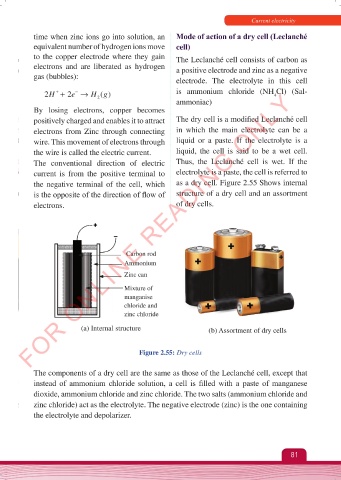
the negative terminal of the cell, which as a dry cell. Figure 2.55 Shows internal
is the opposite of the direction of flow of structure of a dry cell and an assortment
electrons. of dry cells.
Carbon rod
Ammonium
Zinc can
Mixture of
manganise
chloride and
zinc chloride
(a) Internal structure (b) Assortment of dry cells
Figure 2.55: Dry cells
The components of a dry cell are the same as those of the Leclanché cell, except that
instead of ammonium chloride solution, a cell is filled with a paste of manganese
dioxide, ammonium chloride and zinc chloride. The two salts (ammonium chloride and
zinc chloride) act as the electrolyte. The negative electrode (zinc) is the one containing
the electrolyte and depolarizer.
81
Physics Form 2 Final.indd 81 25/10/2025 10:26

