


Page 91 - Physics_Form_2
P. 91
Current electricity

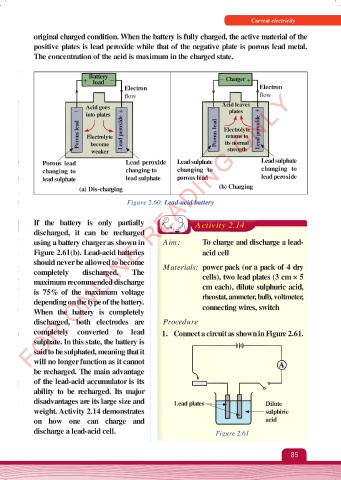
           original charged condition. When the battery is fully charged, the active material of the
           positive plates is lead peroxide while that of the negative plate is porous lead metal.
           The concentration of the acid is maximum in the charged state.


                            Battery
                          +  load  –                               –  Charger +
                                       Electron                                 Electron
          FOR ONLINE READING ONLY
                                       flow                                     flow
                       –   Acid goes  +                          –  Acid leaves   +
                                                                      plates
                           into plates
                         Porous lead  Electrolyte  Lead peroxide  Porous lead  Electrolyte  Lead peroxide
                                                                     returns to
                                                                     its normal
                            become
                             weaker                                   strength
              Porous lead              Lead peroxide   Lead sulphate            Lead sulphate
              changing to              changing to     changing to              changing to
              lead sulphate            lead sulphate   porous lead              lead peroxide
                         (a) Dis-charging                          (b) Charging
                                       Figure 2.60: Lead-acid battery


           If the battery is only partially                 Activity 2.14
           discharged, it can  be recharged
           using a battery charger as shown in    Aim:        To charge and discharge a lead-
           Figure 2.61(b). Lead-acid batteries                acid cell
           should never be allowed to become      Materials:  power pack (or a pack of 4 dry
           completely     discharged.    The                  cells), two lead plates (3 cm × 5
           maximum recommended discharge                      cm each), dilute sulphuric acid,
           is 75% of the  maximum  voltage                    rheostat, ammeter, bulb, voltmeter,
           depending on the type of the battery.
           When the battery is completely                     connecting wires, switch
           discharged, both electrodes  are       Procedure
           completely  converted  to lead         1.  Connect a circuit as shown in Figure 2.61.
           sulphate. In this state, the battery is
           said to be sulphated, meaning that it
           will no longer function as it cannot                                      A
           be recharged. The main advantage
           of the lead-acid accumulator is its
           ability  to be recharged. Its major
           disadvantages are its large size and       Lead plates                Dilute
           weight. Activity 2.14 demonstrates                                    sulphiric
           on how one  can  charge  and                                          acid
           discharge a lead-acid cell.                            Figure 2.61


                                                                                         85


     Physics Form 2 Final.indd   85                                                         25/10/2025   10:26

