


Page 90 - Physics_Form_2
P. 90
Physics for Secondary Schools


           are all called primary cells. In   from  coming  into  contact  thereby  avoiding  the
           this type of cell, the current is   production of a short circuit. The positive plates
           produced from non-recoverable     are made of lead dioxide while the negative plates
           or    irreversible    chemical    are made of porous lead metal. The two sets of
           reactions. For example,  when     plates with the separators between them are placed
           all  zinc  has been  dissolved  in   in  a  container  filled  with  a  dilute  solution  of
          FOR ONLINE READING ONLY
           a  simple  cell, it  will  never  be   sulphuric acid. The term lead-acid refers to the lead
           recovered to its original form    plates and the sulphuric acid which are the main
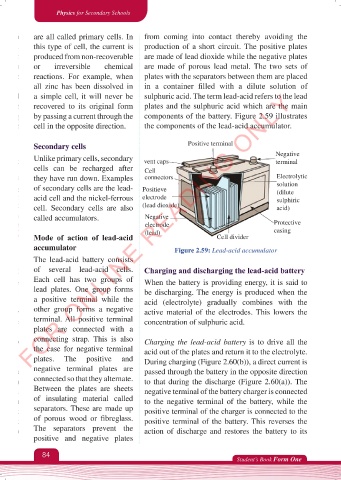
           by passing a current through the   components of the battery. Figure 2.59 illustrates
           cell in the opposite direction.   the components of the lead-acid accumulator.

           Secondary cells                                Positive terminal
           Unlike primary cells, secondary   vent caps                              Negative
                                                                                    terminal
           cells can be recharged after      Cell
           they have run down. Examples      connectors                              Electrolytic
           of secondary cells are the lead-  Positieve                               solution
                                                                                     (dilute
           acid cell and the nickel-ferrous   electrode                              sulphiric
           cell. Secondary cells are also   (lead dioxide)                           acid)
           called accumulators.              Negative
                                             electrode                              Protective
                                                                                    casing
           Mode  of  action  of  lead-acid   (lead)                Cell divider
           accumulator                                Figure 2.59: Lead-acid accumulator
           The  lead-acid  battery  consists
           of several lead-acid  cells.      Charging and discharging the lead-acid battery
           Each  cell  has two groups of     When the battery is providing energy, it is said to
           lead  plates.  One group forms    be discharging. The energy is produced when the
           a  positive  terminal  while  the   acid (electrolyte)  gradually combines with the
           other group forms a negative      active  material  of the  electrodes. This lowers the
           terminal. All  positive  terminal   concentration of sulphuric acid.
           plates  are connected  with a
           connecting  strap.  This is also   Charging the lead-acid battery  is to drive all the
           the case for negative  terminal   acid out of the plates and return it to the electrolyte.
           plates.  The    positive   and    During charging (Figure 2.60(b)), a direct current is
           negative  terminal plates are     passed through the battery in the opposite direction
           connected so that they alternate.   to that during the discharge (Figure 2.60(a)). The
           Between  the  plates  are  sheets   negative terminal of the battery charger is connected
           of insulating material  called    to  the  negative  terminal  of the  battery, while  the
           separators. These are made up     positive terminal of the charger is connected to the
           of  porous  wood  or  fibreglass.   positive terminal of the battery. This reverses the
           The separators prevent the        action of discharge and restores the battery to its
           positive  and negative  plates

              84
                                                                         Student’s Book Form One


     Physics Form 2 Final.indd   84                                                         25/10/2025   10:26

