


Page 171 - Computer_Science_F5
P. 171
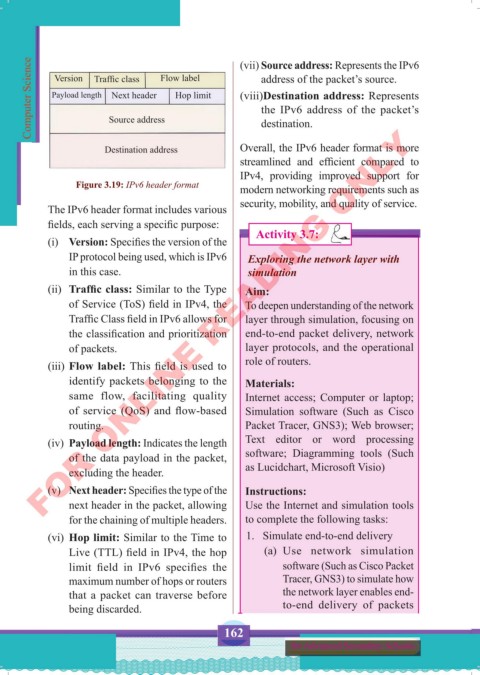
Computer Science  Payload length  Source address  Hop limit  (vii) Source address: Represents the IPv6
                                                         address of the packet’s source.
             Version
                                   Flow label
                     Traffic class
                                                     (viii)Destination address: Represents
                         Next header
                                                         the IPv6 address of the packet’s
                                                         destination.
          FOR ONLINE READING ONLY
                       Destination address           Overall, the IPv6 header format is more
                                                     streamlined  and  efficient  compared  to
                                                     IPv4, providing improved support for
                 Figure 3.19: IPv6 header format     modern networking requirements such as
                                                     security, mobility, and quality of service.
           The IPv6 header format includes various
           fields, each serving a specific purpose:
                                                         Activity 3.7:
           (i)  Version: Specifies the version of the
                IP protocol being used, which is IPv6   Exploring the network layer with
                in this case.                         simulation
           (ii)  Traffic class: Similar to the Type   Aim:
                of Service (ToS) field in IPv4, the   To deepen understanding of the network
                Traffic Class field in IPv6 allows for   layer through simulation, focusing on
                the classification and prioritization   end-to-end packet delivery, network
                of packets.                           layer protocols, and the operational
           (iii) Flow label: This field is used to    role of routers.
                identify packets belonging to the     Materials:
                same flow, facilitating quality       Internet access; Computer or laptop;
                of service (QoS) and flow-based       Simulation  software  (Such as Cisco
                routing.                              Packet Tracer, GNS3); Web browser;
           (iv)  Payload length: Indicates the length   Text  editor  or  word processing
                of the data payload in the packet,    software;  Diagramming  tools (Such
                excluding the header.                 as Lucidchart, Microsoft Visio)

           (v)  Next header: Specifies the type of the   Instructions:
                next header in the packet, allowing   Use the Internet and simulation tools
                for the chaining of multiple headers.  to complete the following tasks:
           (vi)  Hop limit: Similar to the Time to    1.  Simulate end-to-end delivery
                Live (TTL) field in IPv4, the hop         (a)  Use network simulation
                limit  field  in  IPv6  specifies  the        software (Such as Cisco Packet
                maximum number of hops or routers             Tracer, GNS3) to simulate how
                that a packet can traverse before             the network layer enables end-
                being discarded.                              to-end delivery of packets

                                                 162
                                                                for Advanced Secondary Schools


     Computer Science Form 5.indd   162                                                     23/07/2024   12:33

