


Page 65 - Theatre_Arts_Form_5
P. 65
Theatre Arts for Advanced Secondary Schools


                 Chapter

                Three                  Performing spaces
        FOR ONLINE READING ONLY


               Introduction


                Theatre performances do not take place in a vacuum. They can take place
                either indoor or outdoor. In this chapter, you will learn the meaning of
                performing space, types of performing spaces, performing space setting and
                parts of stage. The competencies developed will enable you to creatively set
                and use the stage according to the nature of your theatre performance.


                         Think about a performance without a performing space.


            Theatre performing space
            This is an environment where performance takes place. It is referred to as a place
            where theatre audience and performers meet face to face. A performing space can
            be an area built exclusively for showing theatrical productions. It can also be a
            space meant to be used for other activities but converted into a performing space.
            Such places include a playground, a dining hall, a conference hall or a classroom.
            In traditional African context, a performing space can be anywhere. It can be
            at a playground, in the forest or under the tree. The question where a theatrical
            production should take place is one of the key issues theatre directors and the
            production crew should consider before they embark on a production process.
            The following questions must be considered too. How much does it cost to hire
            a space? Does the performing space reflect the nature of the performance? Will
            the target audience afford ticket prices? Is the space accessible and reachable in
            all circumstances? These are just few questions directors should consider as they
            attempt to choose a place where the performance can take place and seek feasible
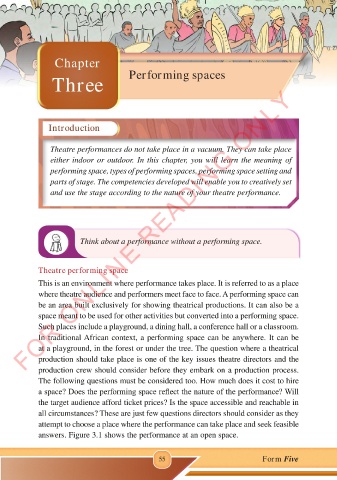
            answers. Figure 3.1 shows the performance at an open space.


                                                55                             Form Five


                                                                                          28/06/2024   15:04
   THEATRE ART F5 fnl.indd   55                                                           28/06/2024   15:04
   THEATRE ART F5 fnl.indd   55

