


Page 68 - Theatre_Arts_Form_5
P. 68
Theatre Arts for Advanced Secondary Schools


            Characteristics of a proscenium stage
                (a) Scene changes are made out of audience’s sight:  The  stage  simplifies
                    changes of scenes due to the presence  of curtains  and backstage.  For
                    example, when the scene ends, the curtains are closed to allow arrangement
                    for the next scene. A backstage simplifies scene changes because it offers
        FOR ONLINE READING ONLY
                    a room for performers to change costumes.

                (b) The separation of audience from performers:  A proscenium stage is
                    usually  raised  several  feet  above  the  audience’s  floor.  This  separates
                    audience  from performers.  The separation  leads the audience  to feel
                    distanced from performers, thus limiting interaction between performers
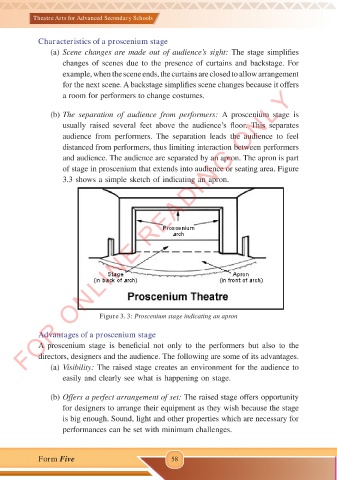
                    and audience. The audience are separated by an apron. The apron is part
                    of stage in proscenium that extends into audience or seating area. Figure
                    3.3 shows a simple sketch of indicating an apron.


                              Figure 3. 3: Proscenium stage indicating an apron

            Advantages of a proscenium stage
            A  proscenium  stage  is  beneficial  not  only  to  the  performers  but  also  to  the
            directors, designers and the audience. The following are some of its advantages.
                (a) Visibility: The raised stage creates an environment for the audience to
                    easily and clearly see what is happening on stage.

                (b) Offers a perfect arrangement of set: The raised stage offers opportunity
                    for designers to arrange their equipment as they wish because the stage
                    is big enough. Sound, light and other properties which are necessary for
                    performances can be set with minimum challenges.


            Form Five                               58


                                                                                          28/06/2024   15:04
   THEATRE ART F5 fnl.indd   58
   THEATRE ART F5 fnl.indd   58                                                           28/06/2024   15:04

