


Page 67 - Theatre_Arts_Form_5
P. 67
Theatre Arts for Advanced Secondary Schools


               Exercise 3.1

                1.  Your class has streams A and B. Both streams have been invited to attend
                   the weekly class performance. Members from stream B seem confused
                   whenever the term performing space is mentioned. Provide hints that you
        FOR ONLINE READING ONLY
                   will use to help them understand its meaning.
                2.  You are attending a form three stage play rehearsal as a guest speaker. Your
                   Theatre Arts teacher has requested you to explain to the students the reasons
                   to why the arena, proscenium and thrust stages are called the basic types.
                3.  Enlighten your classmates in your group discussion who are wondering
                   to why black box, found and mobile stages are categorised as other
                   types.


            Proscenium stage

            This is a performing space in which the audience sits looking at one direction.
            The stage is usually located direct to the audiences’ sitting area. A proscenium
            stage is also called a picture-frame stage because of four walls, which resemble
            the frame of the picture. The stage is located at higher level than the audience’s
            floor. In most cases, proscenium stages are covered by curtains which are usually
            opened when performances begin and closed when performances end. Curtains
            are also used in changing scenes. In Tanzania, proscenium stages are found at
            the Bagamoyo Institute of Arts and Culture (TaSUBa), Chimwaga Hall at the
            University of Dodoma, the National Museum theatre and Little Theatre in Dar es
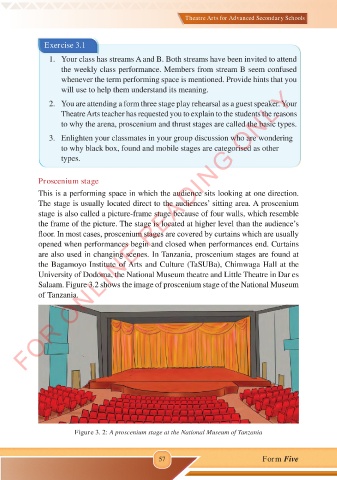
            Salaam. Figure 3.2 shows the image of proscenium stage of the National Museum
            of Tanzania.


                       Figure 3. 2: A proscenium stage at the National Museum of Tanzania


                                                57                             Form Five


                                                                                          28/06/2024   15:04
   THEATRE ART F5 fnl.indd   57                                                           28/06/2024   15:04
   THEATRE ART F5 fnl.indd   57

