


Page 127 - Mathematics_F1
P. 127
10.   The trapezium is formed using the points A( −  2, −  2),  B(5, 2),−   B(5, 2),−
                    and  D(4,3).  Use the given points to draw the trapezium and determine
                    its height by counting the number of unit boxes.

        FOR ONLINE READING ONLY
            Gradient of a straight line
            A straight line is formed by joining two distinct points. Any two points lying on
            the straight line can be used to define it. The nature of the straight line is described
            by its gradient. That is, it can be horizontal, vertical or slanted. The concept of
            gradient is applicable in many real-life activities such as lifting heavy loads,
    Tanzania Institute of Education
            climbing mountains, determining steepness during road construction and many
            other applications. Engage in Activity 6.2 to learn how to recognise the gradient
            of a straight line.


               Activity 6.2: Recognising the gradient of a straight line

               1.    Use a graph paper to plot the points A (2, 1), B (5, 6), C (2, 7), and
                    D(6, 1) on the same xy-plane.
               2.   Find the difference between the x-coordinates and between

                    y-coordinates of  AB,   CD,   BA,  and  DC.
               3.     Find the ratio of the difference of  y-coordinates to x-coordinates obtained
                    in task 2.
               4.   The relationship between the ratios obtained in step 3 is called the gradient
                    of a line.
               5.  Explain how the value obtained in task 3 determines the nature of a line.


            A gradient is a measure of steepness of a straight line and it is usually denoted
            by m. The other name of gradient is slope. In coordinate geometry, the standard
            way to define the gradient of a straight line is by finding the ratio between the
            change in y (vertical increase) to the change in  x  (horizontal increase), that is,
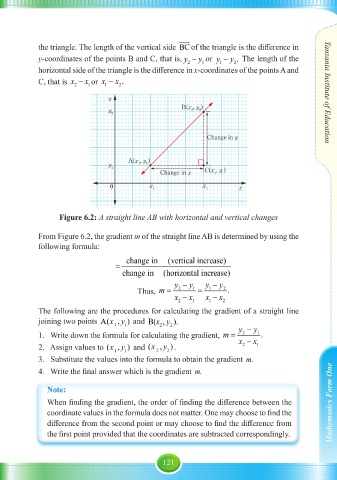
    Mathematics Form One  Consider a line passing through the points A(x , y )  and   B(x , y ) Also, consider
                                                change in y
                                                            coordinates
                                  Gradient, m =
                                                            coordinates
                                                change in x

                                                           1
                                                                          2
                                                                       2
                                                         1
            a right-angled triangle ABC with the straight line  AB shown in Figure 6.2. The
            gradient of a line passing through points A and B is determined by the ratio of
            the length of the vertical side of the triangle to the length of the horizontal side of
                                                 120


                                                                                        25/09/2025   15:01:30
   Mathematics form 1.indd   120
   Mathematics form 1.indd   120                                                        25/09/2025   15:01:30

