


Page 129 - Agriculture_Form_3
P. 129
Agriculture for Secondary Schools


                  Chapter


                     Eight               Pigeon pea production


          FOR ONLINE READING ONLY


                        Introduction

              In this chapter, you will learn the principles and practices underlying pigeon
              pea production for optimum productivity. The competencies  developed  will
              enable you to identify various opportunities in the value chain of pigeon pea
              production and apply principles and practices in the production of pigeon peas
              for commercial and home consumption.


                          Think


                     A drought-tolerant legume with a woody stem


              Pigeon pea and its importance

              Pigeon pea (Cajanus cajan) is an important crop grown in many parts of Tanzania.
              It grows well in areas with adequate rainfall ranging from 600-1000mm. Being
              a drought-tolerant crop, it can also grow in areas with low rainfall below its
              optimum range. The crop also thrives well in relatively nutrient-deficient soil.
              Pigeon peas can give substantial yield even under minimum care, making it an
              appropriate food and cash crop for both small-scale and medium-scale farmers.
              Farmers plant pigeon peas in open fields, home gardens, or mixed with other
              crops such as maize, millet and sorghum.

              Based on uses, pigeon pea is grown as a vegetable, pulse or both. As a vegetable,
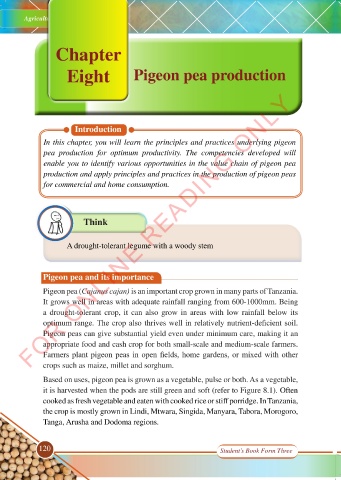
              it is harvested when the pods are still green and soft (refer to Figure 8.1). Often
              cooked as fresh vegetable and eaten with cooked rice or stiff porridge. In Tanzania,
              the crop is mostly grown in Lindi, Mtwara, Singida, Manyara, Tabora, Morogoro,
              Tanga, Arusha and Dodoma regions.


             120                                                    Student’s Book Form Three


                                                                                            17/09/2025   14:12
     AGRICULTURE F3.indd   120                                                              17/09/2025   14:12
     AGRICULTURE F3.indd   120

