


Page 130 - Agriculture_Form_3
P. 130
Agriculture for Secondary Schools


          FOR ONLINE READING ONLY


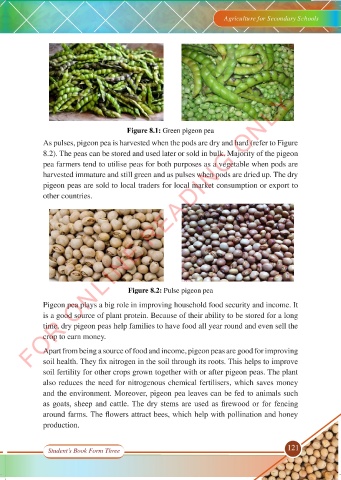
                                       Figure 8.1: Green pigeon pea
              As pulses, pigeon pea is harvested when the pods are dry and hard (refer to Figure
              8.2). The peas can be stored and used later or sold in bulk. Majority of the pigeon
              pea farmers tend to utilise peas for both purposes as a vegetable when pods are
              harvested immature and still green and as pulses when pods are dried up. The dry
              pigeon peas are sold to local traders for local market consumption or export to
              other countries.


                                        Figure 8.2: Pulse pigeon pea
              Pigeon pea plays a big role in improving household food security and income. It
              is a good source of plant protein. Because of their ability to be stored for a long
              time, dry pigeon peas help families to have food all year round and even sell the
              crop to earn money.

              Apart from being a source of food and income, pigeon peas are good for improving
              soil health. They fix nitrogen in the soil through its roots. This helps to improve
              soil fertility for other crops grown together with or after pigeon peas. The plant
              also reduces the need for nitrogenous chemical fertilisers, which saves money
              and the environment. Moreover, pigeon pea leaves can be fed to animals such
              as goats, sheep and cattle. The dry stems are used as firewood or for fencing
              around farms. The flowers attract bees, which help with pollination and honey
              production.


                Student’s Book Form Three                                               121


                                                                                            17/09/2025   14:12
     AGRICULTURE F3.indd   121                                                              17/09/2025   14:12
     AGRICULTURE F3.indd   121

