


Page 217 - Agriculture_Form_3
P. 217
Agriculture for Secondary Schools


              Once inside the body, these pathogens cause many problems. Cattle may develop
              fever, cough, diarrhoea, skin rashes or lumps, and lose weight. In serious cases,
              the disease can kill  the animal.  Some diseases, like  lumpy skin disease and
              brucellosis, spread easily between animals if not controlled quickly. That is why
              clean-living conditions, proper feeding, regular checks, and good care are very
          FOR ONLINE READING ONLY
              important in keeping cattle healthy.
              Vaccination is a key practice in protecting cattle against certain diseases. Vaccines
              help the animal’s body fight off diseases before they become serious. The timing
              of vaccines matters; some are given once or twice a year, while others, such as
              those of East Coast Fever (ECF) and brucellosis, can be given at any time consult
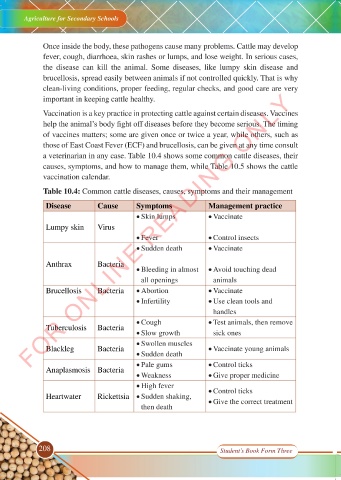
              a veterinarian in any case. Table 10.4 shows some common cattle diseases, their
              causes, symptoms, and how to manage them, while Table 10.5 shows the cattle
              vaccination calendar.

              Table 10.4: Common cattle diseases, causes, symptoms and their management

               Disease         Cause      Symptoms              Management practice
                                          • Skin lumps          • Vaccinate
               Lumpy skin      Virus
                                          • Fever               • Control insects
                                          • Sudden death        • Vaccinate

               Anthrax         Bacteria
                                          • Bleeding in almost   • Avoid touching dead
                                            all openings         animals
               Brucellosis     Bacteria   • Abortion            • Vaccinate
                                          • Infertility         • Use clean tools and
                                                                 handles
                                          • Cough               • Test animals, then remove
               Tuberculosis    Bacteria
                                          • Slow growth          sick ones
                                          • Swollen muscles
               Blackleg        Bacteria                         • Vaccinate young animals
                                          • Sudden death
                                          • Pale gums           • Control ticks
               Anaplasmosis Bacteria
                                          • Weakness            • Give proper medicine
                                          • High fever
               Heartwater      Rickettsia • Sudden shaking,     • Control ticks
                                                                • Give the correct treatment
                                            then death


             208                                                    Student’s Book Form Three


                                                                                            17/09/2025   14:12
     AGRICULTURE F3.indd   208
     AGRICULTURE F3.indd   208                                                              17/09/2025   14:12

